- English
- French
- German
- Portuguese
- Spanish
- Russian
- Japanese
- Korean
- Arabic
- Greek
- German
- Turkish
- Italian
- Danish
- Romanian
- Indonesian
- Czech
- Afrikaans
- Swedish
- Polish
- Basque
- Catalan
- Esperanto
- Hindi
- Lao
- Albanian
- Amharic
- Armenian
- Azerbaijani
- Belarusian
- Bengali
- Bosnian
- Bulgarian
- Cebuano
- Chichewa
- Corsican
- Croatian
- Dutch
- Estonian
- Filipino
- Finnish
- Frisian
- Galician
- Georgian
- Gujarati
- Haitian
- Hausa
- Hawaiian
- Hebrew
- Hmong
- Hungarian
- Icelandic
- Igbo
- Javanese
- Kannada
- Kazakh
- Khmer
- Kurdish
- Kyrgyz
- Latin
- Latvian
- Lithuanian
- Luxembou..
- Macedonian
- Malagasy
- Malay
- Malayalam
- Maltese
- Maori
- Marathi
- Mongolian
- Burmese
- Nepali
- Norwegian
- Pashto
- Persian
- Punjabi
- Serbian
- Sesotho
- Sinhala
- Slovak
- Slovenian
- Somali
- Samoan
- Scots Gaelic
- Shona
- Sindhi
- Sundanese
- Swahili
- Tajik
- Tamil
- Telugu
- Thai
- Ukrainian
- Urdu
- Uzbek
- Vietnamese
- Welsh
- Xhosa
- Yiddish
- Yoruba
- Zulu
Why ASTM A105 Steel Flanges Excel in High-Temperature & High-Pressure Piping Systems
Aug 28 2026
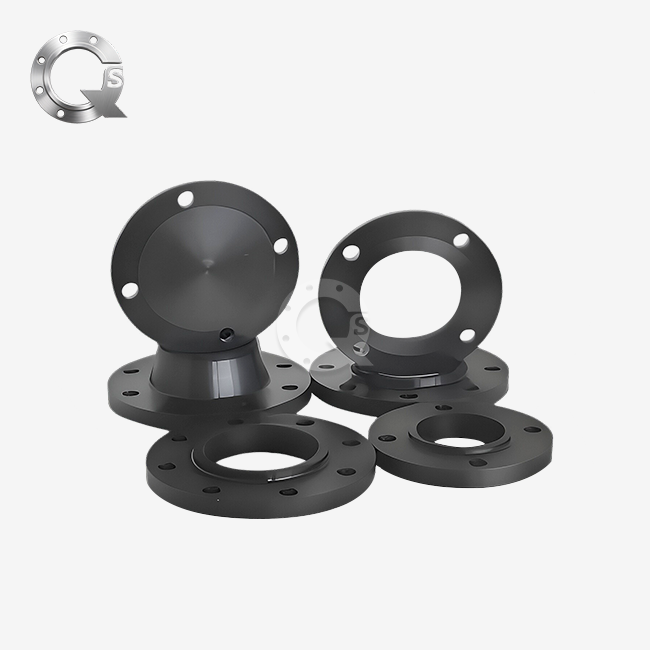
ASTM A105 Steel Flanges are the industry standard for carbon steel piping components used in high-temperature and high-pressure services. As the backbone of industrial piping infrastructure, these forged components offer a unique balance of mechanical strength, weldability, and cost-effectiveness that few other materials can match. Whether in power generation plants, oil refineries, or chemical processing facilities, the reliability of a piping system often hinges on the quality of its connections. This guide delves into the technical reasons why A105 remains the premier choice for critical applications, exploring its metallurgy, manufacturing standards, and performance under stress.
The Metallurgical Advantage of Forged Carbon Steel
To understand why these flanges perform so well under extreme conditions, one must look at the manufacturing process. Unlike cast components, which are poured into molds, ASTM A105 components are forged. Forging involves the application of compressive forces to heat-treated steel, shaping it into the desired form while it is in a solid state.
Grain Structure Refinement
The primary benefit of forging is the alteration of the metal's grain structure. As the steel is deformed, the grain flow is directed to follow the contours of the flange shape. This results in a continuous grain structure that offers superior strength compared to the random grain orientation found in castings or the anisotropic properties of bar stock.
For A105 forged flanges, this means:
· Higher Impact Strength: The ability to absorb energy without fracturing.
· Improved Fatigue Resistance: Essential for systems subject to vibration or thermal cycling.
· Fewer Internal Defects: The forging process closes voids and air pockets that are common in castings, significantly reducing the risk of leaks under high pressure.
Mechanical Properties and Chemical Composition
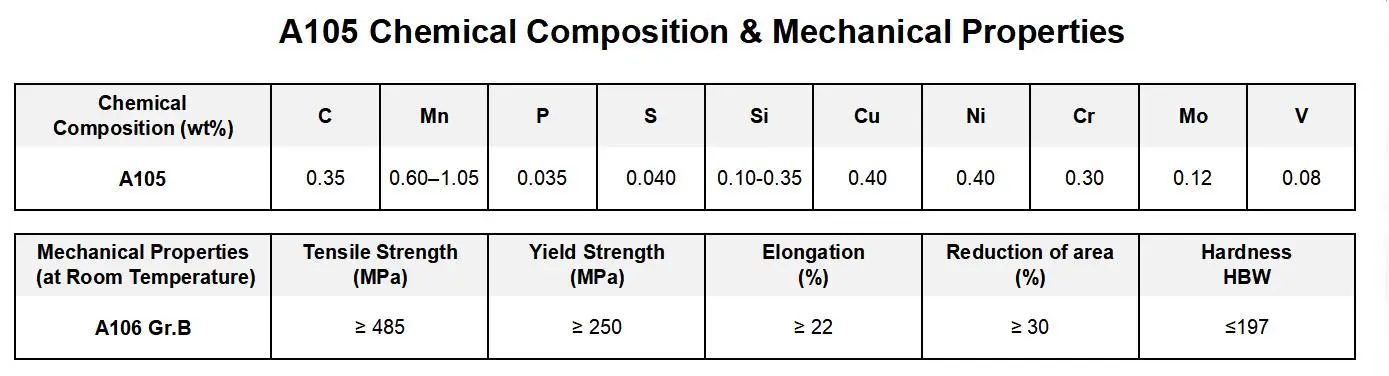
The specific chemical makeup of ASTM A105 is tuned to provide optimal performance in temperatures ranging from -29°C to roughly 538°C. While it is a carbon-manganese steel, the strict control of alloying elements ensures consistent mechanical behavior.
Key Chemical Requirements
The chemical composition is strictly regulated to ensure weldability and strength.
· Carbon (C): Maximum 0.35%. Carbon provides strength but must be controlled to maintain ductility.
· Manganese (Mn): 0.60% to 1.05%. Manganese increases tensile strength and hardness.
· Silicon (Si): 0.15% to 0.35%. Used as a deoxidizer.
· Sulfur and Phosphorus: Kept to minimum levels (0.050% max) to prevent hot shortness and brittleness.
Mechanical Strength Metrics
The mechanical properties are what allow ASTM A105 piping flanges to handle high-pressure ratings.
· Tensile Strength: The material must exhibit a minimum tensile strength of 485 MPa (70 ksi).
· Yield Strength: A minimum yield strength of 250 MPa (36 ksi) ensures the flange maintains its shape under load.
· Elongation: Minimum 30% elongation indicates good ductility, allowing the material to deform slightly before fracturing, which is a critical safety feature in pressurized systems.
Performance in High-Temperature Environments
One of the defining characteristics of ASTM A105 is its ability to retain structural integrity at elevated temperatures. In industries like power generation and hydrocarbon processing, piping systems often transport fluids at temperatures exceeding 400°C.
Thermal Stability and Creep Resistance
At high temperatures, metals can suffer from "creep," a tendency to slowly deform under constant mechanical stress. The carbon-manganese composition of A105 provides excellent resistance to creep and rupture. Furthermore, the thermal expansion coefficient of A105 is well-documented, allowing engineers to accurately calculate pipe growth and design expansion loops or joints to accommodate it.
When the system undergoes thermal cycling—heating up and cooling down repeatedly—the carbon steel flange must withstand the resulting thermal stresses. The homogeneous microstructure achieved through proper heat treatment (normalizing) ensures that the flange expands and contracts uniformly, preventing warping or cracking at the weld joints.
Withstanding High-Pressure Ratings
Pressure containment is the primary function of any flange. ASTM A105 components are manufactured to meet the dimensional standards of ASME B16.5 (for NPS 1/2 to 24) and ASME B16.47 (for larger diameters). These standards define specific pressure-temperature ratings for different flange classes.
Understanding Pressure Classes
The "Class" of a flange (e.g., Class 150, 300, 600, 900, 1500, 2500) denotes its pressure-bearing capacity at a specific temperature.
· Class 150: Suitable for lower pressure applications.
· Class 300 and above: Required as pressure or temperature increases.
For example, a Class 300 A105 flange can withstand a working pressure of roughly 720 psi at ambient temperature, but this rating drops as the temperature rises. However, because of the high yield strength of the A105 material, it maintains a safe operating margin even at these elevated temperatures.
The Role of Wall Thickness
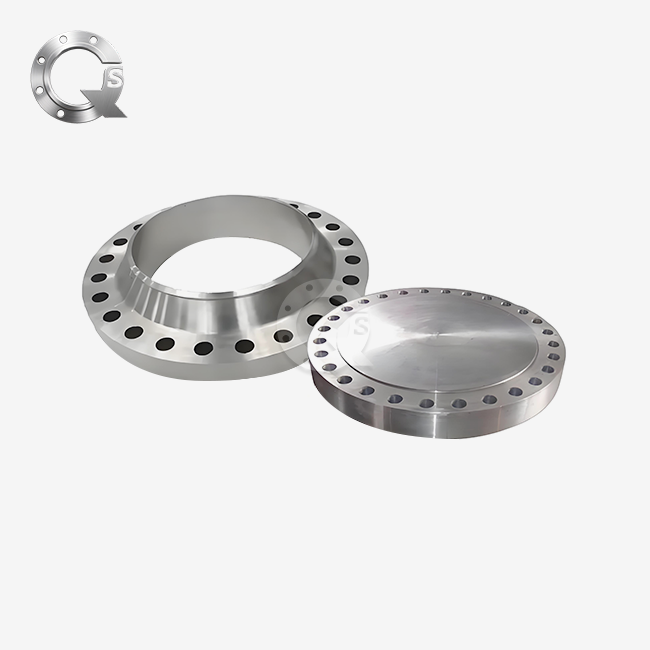
High-pressure flanges typically feature a Weld Neck design. The "neck" provides a tapered transition from the flange ring to the pipe wall thickness. This geometry reduces stress concentration at the base of the flange, which is a common failure point in high-pressure systems. The butt-weld connection used with Weld Neck flanges also provides superior integrity compared to slip-on or threaded connections.
Compatibility with Piping Materials

Versatility is another reason why ASTM A105 Steel Flanges are ubiquitous. They are designed to be compatible with a wide range of piping materials used in industrial settings.
Welding Compatibility
A105 flanges are ideal for connecting carbon steel pipes such as:
· ASTM A106 Grade B: Seamless carbon steel pipe for high-temperature service.
· ASTM A53 Grade B: Welded and seamless steel pipe.
· ASTM A333 Grade 6: Seamless and welded steel pipe for low-temperature service (though A105 has temperature limits, it pairs well in standard environments).
The carbon equivalent (CE) of A105 is generally low enough to ensure good weldability without requiring complex pre-heating or post-weld heat treatment procedures, although specific project codes should always be followed. This ease of welding reduces installation time and labor costs.
Corrosion Considerations and Protection
While ASTM A105 excels in mechanical strength, it is important to acknowledge its limitations regarding corrosion. As a carbon steel, it is susceptible to oxidation (rust) and chemical attack in certain environments.
Protective Measures
To ensure longevity in corrosive environments, several measures are typically taken:
· Coatings: Epoxy, varnish, or oil coatings are applied to the surface to prevent atmospheric corrosion during storage and service.
· Galvanization: While less common for high-temperature flanges due to potential embrittlement, zinc plating can be used for ambient water services.
· Cathodic Protection: Used in underground piping applications.
For highly corrosive fluids (like strong acids), stainless steel or alloy flanges are preferred. However, for the vast majority of oil, gas, water, and steam applications, A105 with appropriate surface protection is the most economical and durable choice.
Quality Control and Testing Standards
Reliability in high-pressure systems is non-negotiable. Therefore, ASTM A105 forged flanges undergo rigorous testing protocols to ensure they meet the required standards.
Nondestructive Examination (NDE)
· Ultrasonic Testing (UT): Used to detect internal flaws, laminations, or voids within the flange body.
· Magnetic Particle Testing (MT): Used to detect surface and near-surface discontinuities.
· Liquid Penetrant Testing (PT): An alternative for detecting surface-breaking defects.
Destructive Testing
Samples from the production batch are subjected to hardness testing, tensile testing, and impact testing (Charpy V-Notch) to verify that the mechanical properties align with the ASTM A105 specification. Manufacturers must provide a Mill Test Certificate (MTC) compliant with EN 10204 3.1, which traces the chemical and physical properties of the specific batch of flanges supplied.
FAQs
Q: What is the maximum temperature limit for ASTM A105 flanges?
A: Generally, ASTM A105 is suitable for service temperatures up to roughly 538°C (1000°F). Above 425°C, there is a risk of carbide precipitation, which can reduce corrosion resistance, though the mechanical strength remains adequate for many applications.
Q: Can ASTM A105 flanges be used in low-temperature services?
A: Standard A105 is not intended for severe low-temperature (cryogenic) service. For temperatures below -29°C, impact testing is required, or a material like ASTM A350 LF2 (Low-Temperature Carbon Steel) should be used instead.
Q: What is the difference between ASTM A105 and A182 F11?
A: A105 is carbon steel, while A182 F11 is a chrome-molybdenum alloy steel. F11 offers better strength and oxidation resistance at very high temperatures but is more expensive. A105 is the standard choice for general high-temperature carbon steel piping.
Q: Are ASTM A105 flanges suitable for sour service?
A: Yes, provided they meet the hardness requirements specified in NACE MR0175 / ISO 15156 to prevent Sulfide Stress Cracking (SSC). The hardness typically needs to be controlled below 200 HB.
Q: What type of welding rod should be used with A105 flanges?
A: For welding A105 to carbon steel pipe, low-hydrogen electrodes such as E7018 (for SMAW) or ER70S-6 (for GTAW/GMAW) are commonly used to match the tensile strength of the base metal.
Contact QinSteel for Expert ASTM A105 Steel Flanges Solutions
Navigating the complexities of high-pressure piping systems requires a partner who understands both the material science and the supply chain. At QinSteel, we specialize in providing high-quality ASTM A105 Steel Flanges that meet the rigorous demands of ASME B16.5 and B16.47 standards. Whether you need standard Weld Neck flanges or custom-forged components for a unique application, our team is ready to assist.
We invite you to contact us for quotes, technical data sheets, or to discuss your specific project requirements.
Email: info@sxqinsteel.com
References
1. ASTM International. (2023). ASTM A105/A105M: Standard Specification for Carbon Steel Forgings for Piping Applications. West Conshohocken, PA.
2. ASME. (2020). ASME B16.5: Pipe Flanges and Flanged Fittings NPS 1/2 through NPS 24 Metric/Inch Standard. New York, NY.
3. ASME. (2017). ASME B16.47: Large Diameter Steel Flanges NPS 26 Through NPS 60 Metric/Inch Standard. New York, NY.
4. NACE International. (2016). NACE MR0175/ISO 15156: Petroleum and natural gas industries — Materials for use in H2S-containing environments.
5. ASME Boiler and Pressure Vessel Code. (2021). Section II: Materials.
Learn about our latest products and discounts through SMS or email