- English
- French
- German
- Portuguese
- Spanish
- Russian
- Japanese
- Korean
- Arabic
- Greek
- German
- Turkish
- Italian
- Danish
- Romanian
- Indonesian
- Czech
- Afrikaans
- Swedish
- Polish
- Basque
- Catalan
- Esperanto
- Hindi
- Lao
- Albanian
- Amharic
- Armenian
- Azerbaijani
- Belarusian
- Bengali
- Bosnian
- Bulgarian
- Cebuano
- Chichewa
- Corsican
- Croatian
- Dutch
- Estonian
- Filipino
- Finnish
- Frisian
- Galician
- Georgian
- Gujarati
- Haitian
- Hausa
- Hawaiian
- Hebrew
- Hmong
- Hungarian
- Icelandic
- Igbo
- Javanese
- Kannada
- Kazakh
- Khmer
- Kurdish
- Kyrgyz
- Latin
- Latvian
- Lithuanian
- Luxembou..
- Macedonian
- Malagasy
- Malay
- Malayalam
- Maltese
- Maori
- Marathi
- Mongolian
- Burmese
- Nepali
- Norwegian
- Pashto
- Persian
- Punjabi
- Serbian
- Sesotho
- Sinhala
- Slovak
- Slovenian
- Somali
- Samoan
- Scots Gaelic
- Shona
- Sindhi
- Sundanese
- Swahili
- Tajik
- Tamil
- Telugu
- Thai
- Ukrainian
- Urdu
- Uzbek
- Vietnamese
- Welsh
- Xhosa
- Yiddish
- Yoruba
- Zulu
Carbon Steel Weld Neck Flanges: The Ultimate Guide to ASME B16.5 Standards & Pressure Ratings
Aug 28 2026
Carbon Steel Weld Neck flanges are the backbone of modern high-pressure piping infrastructure, offering superior strength and fatigue resistance compared to other connection types. Designed to handle rigorous operational conditions, these components are essential for engineers and procurement managers who prioritize safety and longevity in their systems. This guide explores the technical specifications, material grades, and pressure-temperature ratings defined by ASME B16.5, ensuring you can make informed decisions for your next project.
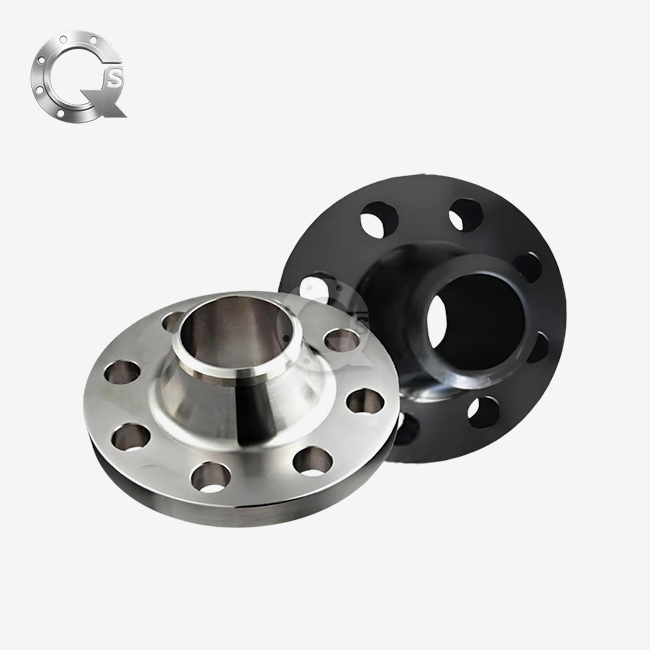
Understanding the Geometry and Stress Distribution
The defining feature of a weld neck connection is its long, tapered hub. Unlike slip-on or socket weld flanges, this design provides a smooth transition of mechanical properties from the pipe to the flange. This geometry is not merely aesthetic; it is a critical engineering solution that reduces stress concentration at the base of the flange.
The Importance of the Tapered Hub
The tapered hub allows for a full-penetration butt weld, which is X-ray inspectable and significantly stronger than the fillet welds used in other flange types. This structural integrity ensures that the WN flange can withstand high pressures, extreme temperatures, and sub-zero conditions without failure. The gradual transition of thickness also helps in distributing mechanical stress more evenly, making it the preferred choice for critical applications in the oil and gas industry.
Decoding ASME B16.5 Standards
When sourcing these components, compliance with ASME B16.5 is non-negotiable for sizes NPS 1/2 through NPS 24. This standard dictates the dimensions, tolerances, and materials used in manufacturing.
Key Dimensions and Tolerances
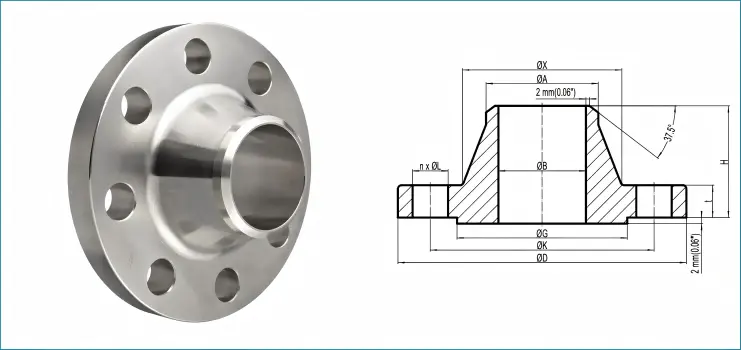
ASME B16.5 ensures that a flange manufactured in one part of the world fits perfectly with a pipe or valve manufactured elsewhere. Key dimensional parameters include:
· Outside Diameter (OD): Must be precise to ensure bolt hole alignment.
· Bore Diameter: Must match the internal diameter of the pipe to minimize turbulence and erosion.
· Flange Thickness: Directly correlates to the pressure class the flange can withstand.
· Raised Face Height: Typically 1/16 inch for Class 150 and 300, and 1/4 inch for Class 400 and above.
Adhering to these standards guarantees interchangeability and safety in complex piping networks.
Pressure-Temperature Ratings Explained
One of the most critical aspects of selecting a Carbon Steel Weld Neck flange is understanding its pressure-temperature rating. The maximum allowable working pressure (MAWP) decreases as the operating temperature increases.
Navigating Pressure Classes
ASME B16.5 categorizes flanges into specific pressure classes, such as Class 150, 300, 600, 900, 1500, and 2500.
· Class 150: Suitable for low-pressure applications, but the pressure rating drops significantly as temperatures approach 400°C.
· Class 300 and above: Required for more demanding services. For example, a Class 300 flange can handle significantly higher pressures at ambient temperatures compared to a Class 150.
Engineers must consult the specific pressure-temperature rating tables for the material grade (e.g., ASTM A105) to ensure the selected flange will not fail under thermal expansion or internal pressure spikes.
Material Grades and Chemical Composition
While "carbon steel" is a broad term, the specific grade determines the flange's weldability, toughness, and corrosion resistance.
ASTM A105: The Industry Standard
ASTM A105 is the standard specification for carbon steel forgings for piping applications. It is the most common material used for forged steel weld neck flanges.
· Chemical Composition: It typically contains Manganese, Silicon, and trace amounts of Copper and Nickel.
· Mechanical Properties: It offers a good balance of tensile strength and yield strength, making it suitable for service temperatures between -29°C and roughly 538°C.
Low-Temperature and High-Yield Options
For cryogenic services, ASTM A350 LF2 is the preferred grade due to its impact toughness at low temperatures. Conversely, for high-pressure transmission pipelines, high-yield grades like ASTM A694 F52 or F60 are utilized to match the strength of the line pipe.
Comparison with Other Flange Types
Why choose a weld neck over other types? The answer lies in performance versus cost.
|
Feature |
Weld Neck (WN) |
Slip-On (SO) |
Socket Weld (SW) |
|
Connection Method |
Butt Weld |
Fillet Weld (Internal & External) |
Fillet Weld |
|
Stress Resistance |
High |
Moderate |
Moderate |
|
Cost |
Higher |
Lower |
Moderate |
|
Best Application |
High Pressure/Temp |
Low Pressure/Non-Critical |
Small Bore High Pressure |
While the initial cost of a WN flange may be higher due to the material volume and machining time, the lifecycle cost is often lower due to reduced maintenance and leak risks.
Manufacturing Processes and Quality Control
The integrity of a flange is determined during its manufacturing. High-quality flanges are forged, not cast. Forging refines the grain structure of the steel, eliminating voids and gas pockets that are common in castings.
Heat Treatment and Testing
After forging and machining, flanges often undergo heat treatment (normalizing or annealing) to relieve stresses and improve machinability. rigorous Quality Control (QC) is essential. This includes:
· Positive Material Identification (PMI): Verifying the chemical composition.
· Ultrasonic Testing (UT): Detecting internal flaws.
· Hydrostatic Testing: Ensuring the flange can withstand pressure without leakage.
Installation Best Practices
Even the highest quality Carbon Steel Weld Neck flange will fail if installed incorrectly. Proper alignment and welding procedures are paramount.
Alignment and Welding
During installation, the flange must be perfectly perpendicular to the pipe axis. Any deviation can cause uneven gasket loading and subsequent leaks. When welding, a root pass should be laid followed by filler passes, ensuring the throat thickness of the weld matches the pipe wall thickness. Pre-heating may be required for thicker sections or high-carbon grades to prevent cracking.
Applications Across Industries
The versatility of these flanges makes them ubiquitous in heavy industry.
· Oil and Gas: Used in upstream extraction and downstream refining where pressures are extreme.
· Power Generation: Essential in steam lines where high temperatures are constant.
· Chemical Processing: Used for transporting volatile fluids where leakage is not an option.
· Shipbuilding: Providing robust connections that can withstand the vibration and stress of marine environments.
Contact QinSteel for Expert Carbon Steel Weld Neck Flange Solutions
Navigating the complexities of piping specifications requires a partner with deep technical expertise and manufacturing capability. At QinSteel, we specialize in producing high-performance piping components that meet the rigorous demands of global industries.
Whether you require standard ASTM A105 flanges or custom alloy solutions for extreme environments, our team is ready to assist with quotes, technical data sheets, and logistical support. We ensure every product leaving our facility meets international standards for quality and safety.
For inquiries regarding pricing, lead times, or custom specifications, please reach out to us directly at info@sxqinsteel.com.
Frequently Asked Questions (FAQs)
What is the maximum temperature for ASTM A105 Weld Neck Flanges?
Generally, ASTM A105 flanges are suitable for service temperatures up to approximately 538°C (1000°F). However, the pressure rating decreases as the temperature increases, so always consult the ASME B16.5 rating tables.
Can Carbon Steel Weld Neck Flanges be galvanized?
Yes, they can be hot-dip galvanized for corrosion protection, particularly in outdoor or marine environments. However, for high-temperature applications, galvanizing is not recommended as the zinc coating can peel or degrade.
What is the difference between a Weld Neck and a Long Weld Neck flange?
A Long Weld Neck (LWN) flange has an extended neck. These are typically used as nozzles for vessels, columns, or tanks, providing reinforcement to the vessel wall, whereas standard weld necks are used for pipe-to-pipe or pipe-to-valve connections.
How do I determine the correct facing for my application?
The most common facing is Raised Face (RF). However, for applications involving toxic or highly volatile fluids, a Ring Type Joint (RTJ) facing is often used with a metal ring gasket to ensure a zero-leakage seal.
References
1. ASME B16.5: Pipe Flanges and Flanged Fittings NPS 1/2 Through NPS 24 Metric/Inch Standard.
2. ASTM A105/A105M: Standard Specification for Carbon Steel Forgings for Piping Applications.
3. ASME B31.3: Process Piping Guide.
4. MSS SP-44: Steel Pipeline Flanges.
Learn about our latest products and discounts through SMS or email