- English
- French
- German
- Portuguese
- Spanish
- Russian
- Japanese
- Korean
- Arabic
- Greek
- German
- Turkish
- Italian
- Danish
- Romanian
- Indonesian
- Czech
- Afrikaans
- Swedish
- Polish
- Basque
- Catalan
- Esperanto
- Hindi
- Lao
- Albanian
- Amharic
- Armenian
- Azerbaijani
- Belarusian
- Bengali
- Bosnian
- Bulgarian
- Cebuano
- Chichewa
- Corsican
- Croatian
- Dutch
- Estonian
- Filipino
- Finnish
- Frisian
- Galician
- Georgian
- Gujarati
- Haitian
- Hausa
- Hawaiian
- Hebrew
- Hmong
- Hungarian
- Icelandic
- Igbo
- Javanese
- Kannada
- Kazakh
- Khmer
- Kurdish
- Kyrgyz
- Latin
- Latvian
- Lithuanian
- Luxembou..
- Macedonian
- Malagasy
- Malay
- Malayalam
- Maltese
- Maori
- Marathi
- Mongolian
- Burmese
- Nepali
- Norwegian
- Pashto
- Persian
- Punjabi
- Serbian
- Sesotho
- Sinhala
- Slovak
- Slovenian
- Somali
- Samoan
- Scots Gaelic
- Shona
- Sindhi
- Sundanese
- Swahili
- Tajik
- Tamil
- Telugu
- Thai
- Ukrainian
- Urdu
- Uzbek
- Vietnamese
- Welsh
- Xhosa
- Yiddish
- Yoruba
- Zulu
What Is a Straight Tee ASME B16.9 and What Does the Standard Cover?
Oct 13 2026
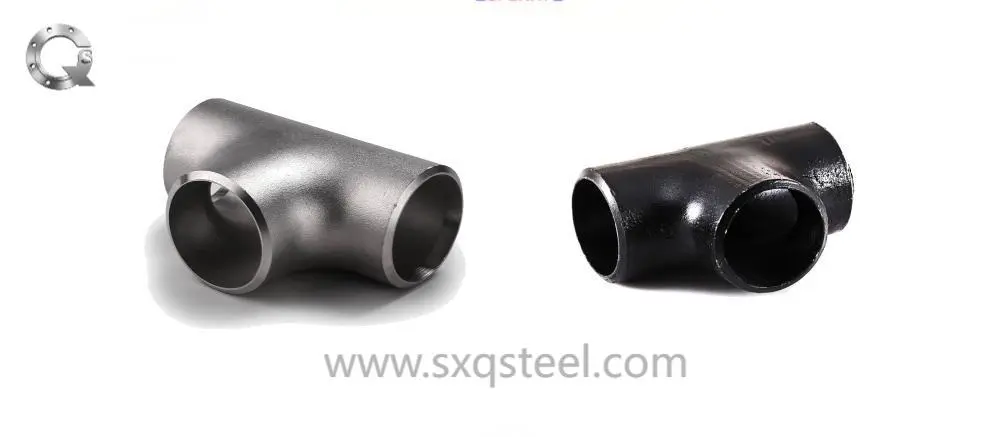
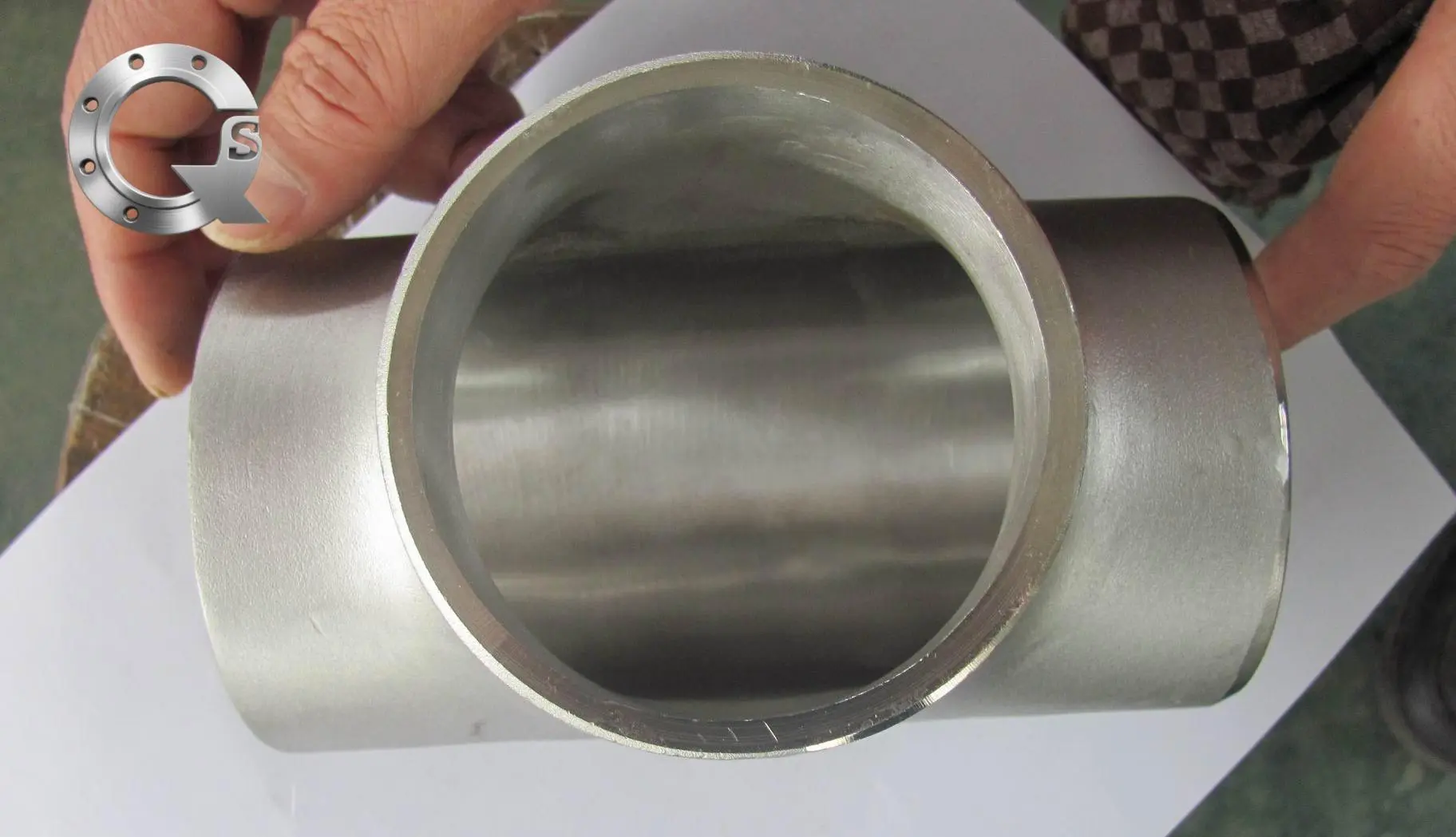
A Straight Tee ASME B16.9 is a butt welding fitting with one outlet at ninety degrees to a straight run, and it is the branch connection that appears on more piping drawings than any other. The standard fixes the outside diameter, the centre to end distance and the wall at the welding ends. It says nothing about how the branch will be supported or what the line carries, and buyers who understand that division of responsibility order the right part.
What ASME B16.9 Covers and What It Leaves Alone
B16.9 is a dimensional standard for wrought butt welding fittings. For a straight tee it sets the outside diameter at the run and at the branch, the centre to end distance, the wall thickness at the four welding ends and the tolerances that apply to each of those figures. It does not set the grade, the heat treatment, the pressure rating or the corrosion allowance.
The practical consequence is that two fittings can both be B16.9 and still not be interchangeable. One may be A234 WPB normalised, the other as formed from a different heat with a different carbon equivalent, and the welding procedure that suits the first may require preheat for the second. On a project where the welder is qualified on one combination, that difference shows up on the first day.
A Straight Tee ASME B16.9 bought against the dimensional standard alone is therefore correct in shape and unknown in material, which is why a purchase order has to carry both documents.
The Run, the Branch and the Crotch
A straight tee has four ends. Two sit on the run and continue the header, one forms the branch outlet, and the crotch is the saddle where the branch meets the run. The crotch carries the highest stress of the four and receives the least inspection, which is the reason a tee is not simply three lengths of pipe welded together at a corner.
Extruded tees pull metal out of the run into the branch, so the branch wall thickens as it leaves the crotch. That thickening is what lets the branch be welded to pipe of the same nominal wall without a reinforcing pad in many services. Where a pad is drawn anyway, it is usually a project rule rather than a calculation, and it is welded after the branch weld has been inspected.
On a Straight Tee ASME B16.9 the crotch profile is formed at the works, not at site, so its shape and its section are fixed before the fitting is ever loaded.
Where the Dimension Tables Take Over
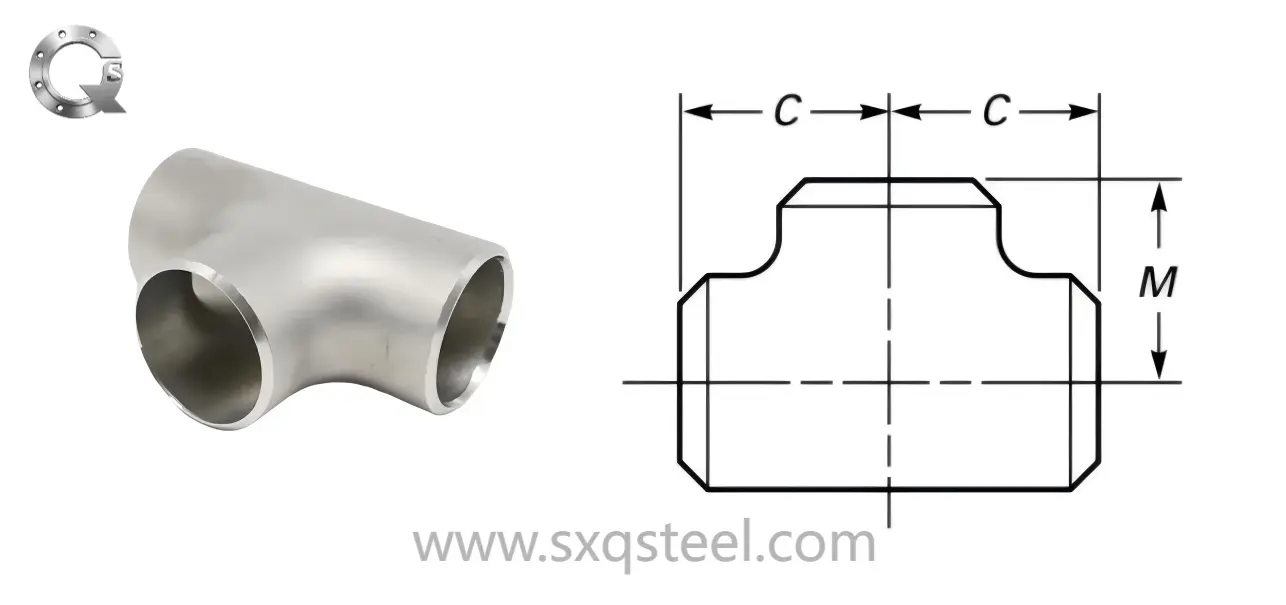
The tables give one controlling figure for a straight tee, the centre to end dimension C, measured from the centreline of the run to the face of the branch. Everything else in the table, the outside diameter and the wall, is inherited from the pipe the fitting has to match.
For an equal tee the run length is twice C, so a fitting for NPS 6 measures 11 1/4 inches along the run and its branch stands 5 5/8 inches off the header centreline. Those figures decide whether a branch outlet lands where a support or a valve has already been drawn. If it does not, the answer is a different fitting, because the centre to end figure is not a dimension a manufacturer can adjust.
Ordered by nominal size, schedule and material, a Straight Tee ASME B16.9 takes its centre to end figure from the size rather than from the buyer.
Materials: Which Specification Goes With Which Tee
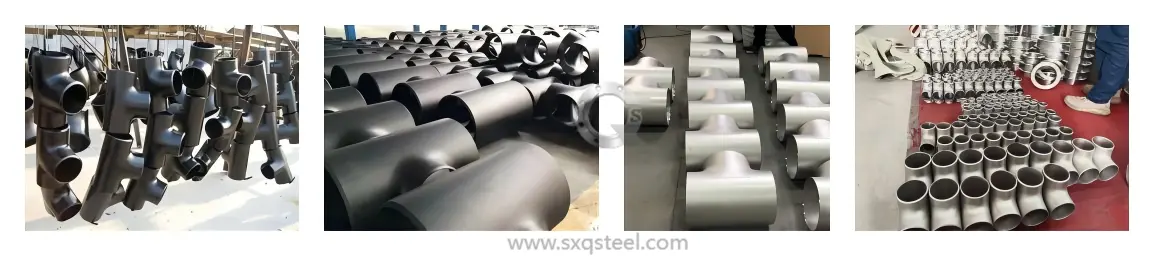
Carbon steel tees are normally ASTM A234 WPB, pairing with A106 or A53 pipe and covering the great majority of water, air, steam and hydrocarbon duty. Low temperature work moves to A420 WPL6. Stainless falls under A403, most often WP304L or WP316L, and alloy grades such as WP11, WP22 and WP91 sit alongside the corresponding pipe specification.
Grade and pipe should be chosen together. A WP316L tee welded into a 304L header is a dissimilar joint with a different expansion and a different corrosion response, and while it can be welded perfectly well it needs a procedure that says so. We see this most often on utility lines fabricated on site, where the tee and the pipe were bought by two different people.
Every Straight Tee ASME B16.9 we quote carries the grade with the dimensional standard on the same line of the offer, so the two cannot be separated later.
Where B16.9 Sits Against the Other Standards
B16.9 is the ASME dimensional document. The material standard sits beside it, B31.3 or B31.1 governs the piping design, and B16.25 governs the bevel. On the European side the comparable fitting standard is EN 10253-2 for carbon and EN 10253-4 for stainless, and the two families are close in shape without being identical in every dimension.
A buyer holding an EN 10253 take-off who orders B16.9 fittings will find most sizes interchangeable at the pipe and a few that are not. The safe route is a size by size comparison rather than an assumption of equivalence, and we will mark up a take-off sheet against the B16.9 tables on request.
A Straight Tee ASME B16.9 and its EN counterpart can differ by a few millimetres at the branch, which is nothing on a drawing and a great deal at a weld.
What to Put in the Enquiry
Six items: nominal size, schedule or wall thickness, material grade with its ASTM or EN designation, end preparation, quantity and destination. If the tee sits in a line class, send the line number. If the branch carries a different fluid from the run, say so, because that single fact changes the material more often than anything else on the sheet.
Photographs help more than a description when the tee is a replacement. A tape measure across the branch face and along the run answers in one image what three emails about a drawing can leave open. Where the original part is unmarked, we ask for the pipe outside diameter at the run ends so the size can be confirmed before a quotation is issued.
Send those six lines for a Straight Tee ASME B16.9 and the reply is a price and a delivery date rather than a further round of questions.
Fit-Up, Bevels and Weld Preparation
We bevel the two run ends and the branch outlet to ASME B16.25 with a 37.5 degree included angle and a root face of roughly 1/16 inch, and we gauge all four faces instead of measuring one and assuming the other three followed it.
Outlet squareness is checked against the run before despatch. A tee whose branch leans by half a degree throws the branch line out by an inch over twenty feet, and no amount of site fit-up recovers that without cutting the spool apart again.
Certification, Traceability and Goods-In Checks
Each tee leaves with a mill test certificate to EN 10204 3.1 giving chemistry, tensile results and heat treatment condition by heat number. Where a project specification demands it we arrange 3.2 with an independent inspector at the works.
The hard stamp carries grade, nominal size, wall and heat number, and we photograph the stamping on the bundle before wrapping. That photograph has settled more than one argument about what was actually shipped.
Packing, Coating and Export Logistics
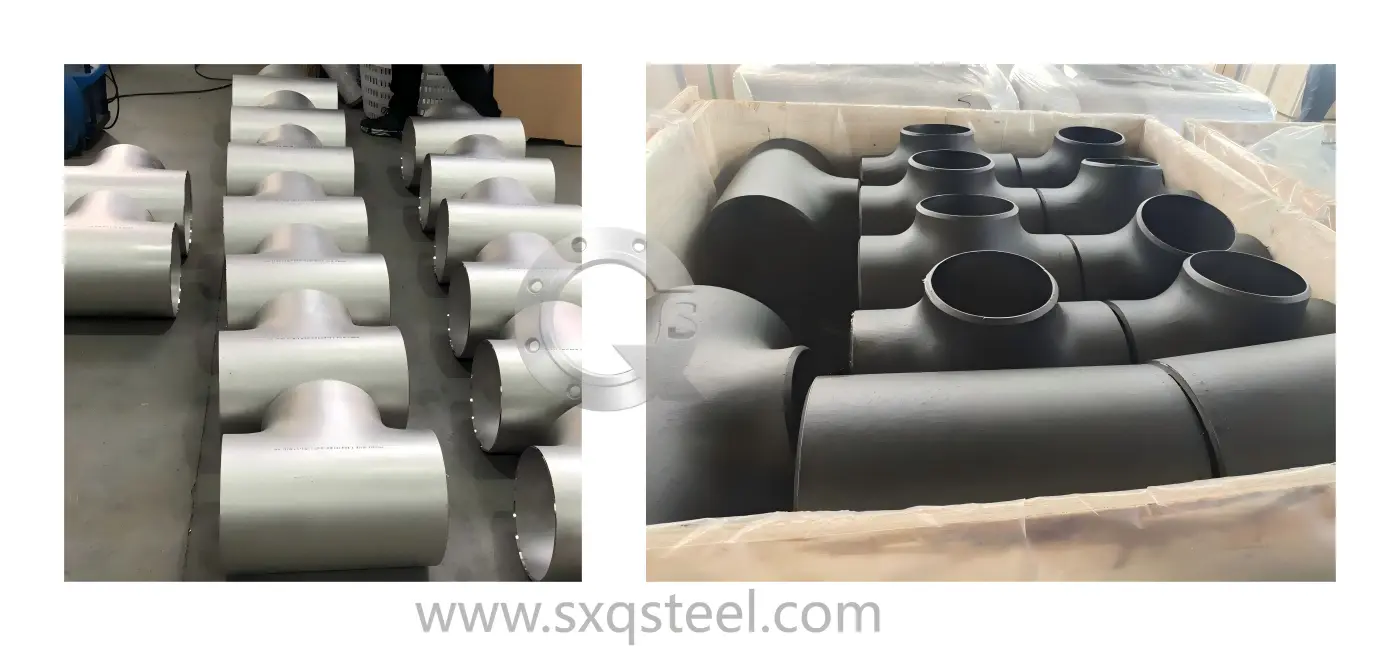
Tees are stacked by size and schedule rather than by order line, because two fittings of the same nominal size in different walls look identical on a pallet and can only be separated with a gauge. Finding that out at the weld is an expensive way to learn it.
Carbon steel destined for a long sea voyage leaves us black painted or oiled and strapped to timber dunnage. Stainless goes out wrapped and stencilled so the grade and heat number can be seen on the pallet, which saves opening a crate in a customs shed.
Stock, Repeat Orders and Phased Release
We keep straight tees from NPS 1/2 to NPS 12 in carbon and stainless so a shutdown order can move within the week. Larger sizes and alloy grades are placed against the mill rolling programme and quoted with a date we can defend.
When a contractor wants the whole quantity bought but only part of it delivered, we store the remainder and release it against his erection sequence, so the compound on site stays clear while the price stays fixed.
How We Confirm the Specification Before We Quote
We ask what the branch carries and how the header is operated before we quote a grade, because a condensate outlet and a steam header drawn on the same sheet can need different materials at the same nominal size.
Where a take-off sheet and a line class disagree we print both readings in the quotation and let the customer decide which governs, rather than quietly pricing the cheaper of the two and hoping nobody notices until the fitting arrives.
How a Straight Tee Is Actually Made
Most tees up to NPS 24 are hot extruded. A length of pipe is cut, heated and pressed so that metal from the run is drawn out to form the branch, which leaves the crotch with a heavier section than the pipe it came from. The part is then trimmed, the outlet cut square and all four ends bevelled.
Large diameter thin wall tees and some alloy grades are fabricated instead, built from a run pipe with a formed outlet welded in and the internal weld ground flush where a pig or a sphere has to pass. Fabricated tees are acceptable wherever the specification allows the route, and the certificate ought to say which one was used.
Why Choose Xi'an QinSteel for Straight Tee ASME B16.9 Supply
We have supplied straight tees into refinery revamps, mine water lines and district heating networks, and the questions we ask are shaped by what went wrong on those jobs rather than by a checklist on a wall. A branch that arrives with the wrong wall costs a contractor a day; a tee with the wrong carbon equivalent can cost a weld procedure. A tee returned from a site costs a week of programme and a telephone argument, while the question that prevents the return costs about a minute. Two of the last three branch mistakes we saw came from a bill of materials that contradicted the drawing it was issued with.
We keep the mill certificate, the dimensional record and the despatch photograph together under the order number, so when an inspector asks two years later what left the works the answer is a folder rather than a search. Where a project needs 3.2 certification we book the third party witness before the parts are packed, not after the vessel has sailed.
We will tell a customer when the fitting he has specified is the wrong shape for the job, even when the alternative costs more, because a branch that cannot be welded in position is not a problem a quotation will solve later. Write to info@sxqinsteel.com or open www.sxqsteel.com and the same desk answers, whether the enquiry is for one tee or a take-off for a whole unit.
| NPS | Pipe OD (in) | Centre to end C (in) | Run length 2C (in) | Branch OD (in) |
|---|---|---|---|---|
| 2 | 2.375 | 2 1/2 | 5 | 2.375 |
| 3 | 3.500 | 3 3/8 | 6 3/4 | 3.500 |
| 4 | 4.500 | 4 1/8 | 8 1/4 | 4.500 |
| 6 | 6.625 | 5 5/8 | 11 1/4 | 6.625 |
| 8 | 8.625 | 7 | 14 | 8.625 |
| 10 | 10.750 | 8 1/2 | 17 | 10.750 |
| 12 | 12.750 | 10 | 20 | 12.750 |
| 16 | 16.000 | 12 | 24 | 16.000 |
| 24 | 24.000 | 16 | 32 | 24.000 |
Frequently Asked Questions
1.Does ASME B16.9 specify the material of a straight tee?
No. B16.9 is dimensional. The material comes from A234 for carbon and alloy steel, A403 for stainless, and A420 for low temperature carbon steel. A purchase order has to name the dimensional standard and the material specification, and a supplier who quotes against only one of them is quoting an incomplete part.
2.Can a straight tee be used as a reducing tee?
Not properly. Reducing a branch is done with a reducing tee, which has a smaller outlet and its own dimensioned branch centre. Welding a reducer onto the outlet of an equal tee adds a joint where the drawing expected none and moves the branch face further from the header than the layout allows for.
3.How is the centre to end dimension measured?
From the centreline of the run to the face of the branch outlet, with the tee resting on the run. It is a fixed figure for each nominal size in the B16.9 table and is not something a manufacturer can adjust to suit a congested layout.
Contact Xi'an QinSteel for Straight Tee ASME B16.9 Solutions
For a Straight Tee ASME B16.9 quotation, send the nominal size, schedule, grade and quantity to info@sxqinsteel.com or through www.sxqsteel.com. Where the tee replaces an existing part, add the pipe outside diameter at the run ends and the branch, and the size is confirmed before the quotation leaves the desk.
References
1.ASME B16.9-2018, Factory-Made Wrought Buttwelding Fittings.
2.ASTM A234/A234M, Standard Specification for Piping Fittings of Wrought Carbon Steel and Alloy Steel for Moderate and High Temperature Service.
3.ASTM A403/A403M, Standard Specification for Wrought Austenitic Stainless Steel Piping Fittings.
4.ASME B16.25, Buttwelding Ends.
5.ASME B36.10M, Welded and Seamless Wrought Steel Pipe.
6.ASME B31.3, Process Piping.
Learn about our latest products and discounts through SMS or email