- English
- French
- German
- Portuguese
- Spanish
- Russian
- Japanese
- Korean
- Arabic
- Greek
- German
- Turkish
- Italian
- Danish
- Romanian
- Indonesian
- Czech
- Afrikaans
- Swedish
- Polish
- Basque
- Catalan
- Esperanto
- Hindi
- Lao
- Albanian
- Amharic
- Armenian
- Azerbaijani
- Belarusian
- Bengali
- Bosnian
- Bulgarian
- Cebuano
- Chichewa
- Corsican
- Croatian
- Dutch
- Estonian
- Filipino
- Finnish
- Frisian
- Galician
- Georgian
- Gujarati
- Haitian
- Hausa
- Hawaiian
- Hebrew
- Hmong
- Hungarian
- Icelandic
- Igbo
- Javanese
- Kannada
- Kazakh
- Khmer
- Kurdish
- Kyrgyz
- Latin
- Latvian
- Lithuanian
- Luxembou..
- Macedonian
- Malagasy
- Malay
- Malayalam
- Maltese
- Maori
- Marathi
- Mongolian
- Burmese
- Nepali
- Norwegian
- Pashto
- Persian
- Punjabi
- Serbian
- Sesotho
- Sinhala
- Slovak
- Slovenian
- Somali
- Samoan
- Scots Gaelic
- Shona
- Sindhi
- Sundanese
- Swahili
- Tajik
- Tamil
- Telugu
- Thai
- Ukrainian
- Urdu
- Uzbek
- Vietnamese
- Welsh
- Xhosa
- Yiddish
- Yoruba
- Zulu
A234 WPB or Stainless: Choosing the Right Grade for a B16.9 Elbow
Oct 13 2026
Elbow B16.9 is a shape, and the shape says nothing about what the fitting is made of. That decision comes from the service, the design temperature and the specification the pipe was bought under, and it is the question we are asked most often after the size. Carbon steel WPB covers the great majority of orders, but alloy, stainless, duplex and high yield grades all have their own territory, and picking the wrong one is expensive in a way that a size error is not. Here is how the main grades divide up and how to match a fitting to the pipe it will be welded to.

The Carbon Steel Default: A234 WPB
ASTM A234 WPB is the grade behind most of the Elbow B16.9 tonnage in the world. It covers moderate and high temperature service from ambient up to around 800 degrees Fahrenheit, it welds forgivingly with ordinary procedures, and it is available in every schedule and size from NPS 1/2 to NPS 48.
The usual partner is ASTM A106 Grade B seamless pipe or API 5L line pipe. WPC is the same family with a silicon killed chemistry for slightly higher temperature capability, and the two are quoted side by side on most enquiries because the difference only matters where the design temperature is close to the limit of the grade.
Alloy Grades for Heat, Hydrogen and Steam
An Elbow B16.9 moves up the alloy scale once a line runs hot enough for creep to matter. WP11, WP22 and WP91 in ASTM A234 carry chromium and molybdenum for steam and hydrogen service, and they are matched to pipe grades such as A335 P11, P22 and P91 rather than to ordinary carbon steel.
Alloy fittings bring welding consequences that a purchase department should know about before the price is accepted: preheat, controlled interpass temperature, post weld heat treatment, and usually hardness limits. A WP22 elbow in a hydrogen line is not a commodity item and should not be bought as one, even though it looks identical to a carbon steel part on the pallet.
Austenitic Stainless in ASTM A403
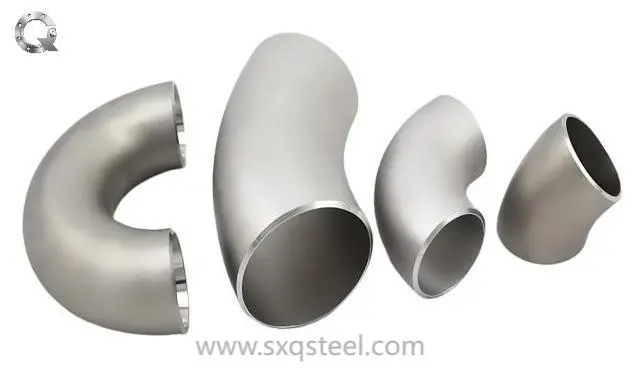
Stainless elbows come under ASTM A403, with WP304L and WP316L the two grades that cover most chemical, pharmaceutical, food and marine work. An Elbow B16.9 in 316L brings molybdenum for chloride resistance, while 304L is the cheaper choice where the service is mildly corrosive or the priority is hygiene and cleanability.
Higher alloys in the same specification include WP321 and WP347, stabilised with titanium or niobium for elevated temperature service where intergranular corrosion would otherwise be a risk. Note that A403 covers both welded and seamless fittings, and the wall for these grades is read from ASME B36.19M rather than B36.10M.
Low Temperature, Duplex and High Yield Options
Below the transition temperature of ordinary carbon steel, notch toughness becomes the governing property and the grade changes. ASTM A420 covers WPL6 and WPL3 for low temperature service down to around minus 50 degrees Fahrenheit, and these are matched to A333 pipe grades.
An Elbow B16.9 in duplex or super duplex comes under ASTM A815, typically UNS S31803 for 2205 and S32750 for super duplex, and both are used where chlorides rule out the austenitic grades. High yield line pipe fittings follow ASTM A860 with WPHY 42 to WPHY 70, usually paired with API 5L pipe of the matching yield class on transmission and sour service work.
Welding a Fitting to a Pipe of a Different Grade
A B16.9 elbow can be welded to a pipe of a different grade, and the practice is routine, but it has to be deliberate. Welding a WP316L elbow to a carbon steel header is done every day, and the filler metal and procedure have to be chosen for the pair rather than for one side of the joint.
The rule we work to is that the fitting should never be the weaker or the less corrosion resistant of the two materials unless the designer has said so. A 316L elbow on a 304L line is wasteful, a 304L elbow on a 316L line is a corrosion cell waiting for a reason to show itself, and neither situation should be discovered at the fit-up.
What the Certificate Has to Show
For any B16.9 elbow the certificate must name the standard, the grade, the heat number and the heat treatment condition, and it should carry the mechanical results for the heat. On a 3.1 certificate the works certifies the results; on a 3.2 certificate an independent body does.
Where a specification adds impact testing, a hardness limit or a corrosion test, those results have to appear as well, and they must relate to the same heat number as the marking on the fitting. A certificate that cannot be tied to a specific heat is of little use to an inspector, whatever else it says.
Fit-Up, Bevels and Weld Preparation
We confirm the pipe grade before we confirm the fitting grade, because the two have to weld together under one procedure and a mismatch is discovered at the joint rather than in the office.
On alloy and stainless work we keep the heat number visible through the packing, so the welding inspector can match a fitting to its certificate without unwrapping a crate and losing the traceability he came to check.
Certification, Traceability and Goods-In Checks
We supply EN 10204 3.1 as standard on every grade and can arrange 3.2 with a third party witness for refinery, nuclear and offshore work where the project specification requires it.
Impact tests, hardness surveys and intergranular corrosion tests can be added to the order, and we will tell a customer when a test he has not asked for is the one his service actually needs.
Packing, Coating and Export Logistics
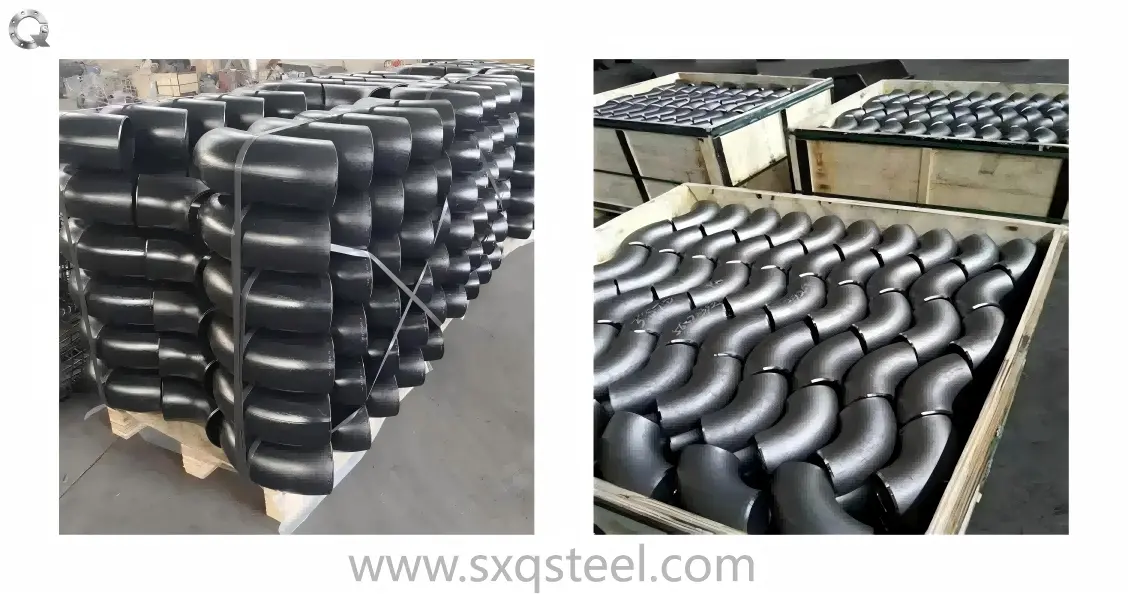
Stainless and carbon steel never travel in the same crate with us, since a carbon steel fitting against a stainless surface is free contamination and the mark it leaves is the sort that shows up in a pickling bath rather than on a packing list.
Alloy and stainless parts are wrapped individually, labelled with grade and heat number, and loaded so that nothing rests on the bevel face of another fitting.
Stock, Repeat Orders and Phased Release
Our stock covers WPB in the common schedules and 304L and 316L in the sizes most often specified for hygienic and chemical work, which is where a short lead time is worth more than a small price advantage.
For alloy grades we plan against the rolling programme rather than against a shelf, and we tell customers the honest lead time at enquiry instead of accepting an order we cannot deliver on the date they need it.
How We Confirm the Specification Before We Quote
We ask for the design temperature, the fluid and the pipe specification before quoting a grade, because the same size and angle can be WPB, WP22 or WP316L and the price moves by a factor rather than a few percent.
If an enquiry names a grade that does not suit the service described, we say so and offer the alternative, since a cheap fitting in the wrong grade is the most expensive item on the bill.
Why the Grade Marker Matters More Than the Price
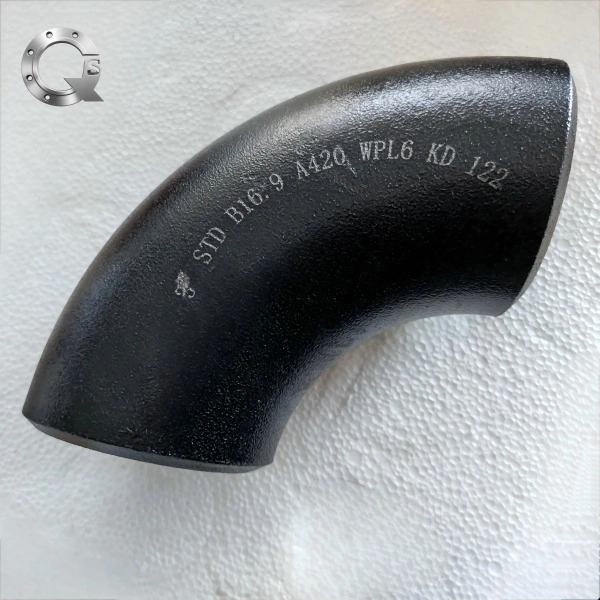
On a pallet, an A234 WPB elbow and an A420 WPL6 elbow of the same size look identical, and both may carry the same mill finish and the same paint. The difference is toughness at low temperature, and it is the difference between a line that holds in a cold snap and one that cracks at a weld.
The same logic runs through the alloy and stainless families. Grade is not a commercial detail to be optimised at the quotation stage; it is a property of the finished joint, and it is fixed by the service rather than by the buyer's budget for a given week.
Why Choose Xi'an QinSteel for Elbow B16.9 Supply
We hold stock across the grades that matter rather than only in carbon steel, which means a chemical plant needing a 316L elbow and a refinery needing WP11 are both served from the same desk instead of one of them being referred elsewhere.
We ask about temperature and fluid before we quote a grade, and we will recommend a cheaper grade when the service allows it, because a customer who buys more alloy than he needs once will not come back to check the next quotation with us.
We keep the heat number legible through packing and on the certificate, so an inspector can walk up to a crate and tie a fitting to its paperwork in a minute. Write to info@sxqinsteel.com or open www.sxqsteel.com and tell us the service rather than only the size, and the grade conversation takes one exchange. On mixed orders we separate the grades physically and label every bundle, since a WPB elbow and a WPL6 elbow of the same size are impossible to tell apart by eye and the difference only shows at the toughness test. If the service conditions are unclear we would rather ask two questions at quotation than ship a fitting that meets the drawing and not the duty.
| Grade | ASTM spec | Typical service | Pipe usually welded to it |
|---|---|---|---|
| WPB | A234 | Ambient to 800 F, general | A106 B, API 5L |
| WPC | A234 | Similar, silicon killed | A106 C |
| WP11 | A234 | Steam and process to 900 F | A335 P11 |
| WP22 | A234 | Hydrogen and steam to 1100 F | A335 P22 |
| WP304L | A403 | Mildly corrosive, cryogenic | A312 TP304L |
| WP316L | A403 | Chlorides, acids, marine | A312 TP316L |
| WP321 | A403 | Stabilised, high temperature | A312 TP321 |
| WPL6 | A420 | Low temperature to minus 50 F | A333 Grade 6 |
| WPHY 60 | A860 | Line pipe, sour service | API 5L X60 |
| S31803 (2205) | A815 | Seawater, high chloride | A790 S31803 |
Frequently Asked Questions
1.Can I use a WPB elbow on a line built to a European specification?
Only if the project specification accepts ASTM material, which many do through an approved equivalents list. Otherwise the fitting has to come with EN 10253-2 certification and a P-number that matches the pipe. The dimensions are frequently interchangeable and the paperwork is not, so the acceptance question is answered by the client's specification rather than by the fitter.
2.Is 316L always better than 304L for a B16.9 elbow?
No. 316L carries molybdenum for chloride and acid resistance, but it costs more, machines less easily and is not automatically the right answer. For mildly corrosive or hygienic service 304L is the appropriate grade, and on high chloride or seawater duty even 316L has limits, which is where duplex starts to be the honest recommendation.
3.What does 3.1 and 3.2 mean on a fitting certificate?
They are EN 10204 inspection document levels. A 3.1 certificate is issued and signed by the manufacturer's own authorised inspection representative on the basis of the works test results. A 3.2 certificate is signed by an independent inspector representing the purchaser or a nominated third party, and it costs more because a person has to witness the test.
Contact Xi'an QinSteel for Elbow B16.9 Solutions
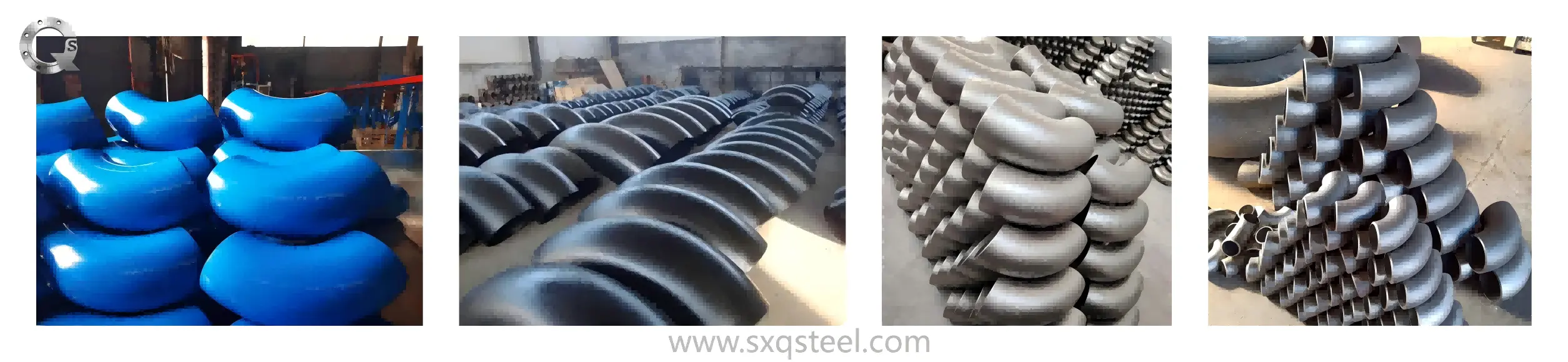
Give us the size, schedule, angle and the service conditions and we will propose the grade for your Elbow B16.9 requirement, in carbon, alloy, stainless or duplex, with the certificate options listed. The export desk is at info@sxqinsteel.com and www.sxqsteel.com, and every quotation names the grade and the standard it is offered against.
References
- ASME B16.9-2018, Factory-Made Wrought Buttwelding Fittings, American Society of Mechanical Engineers.
- ASME B36.10M-2018 and B36.19M-2018, Welded and Seamless Wrought Steel Pipe and Stainless Steel Pipe.
- ASME B16.25-2017, Buttwelding Ends, American Society of Mechanical Engineers.
- ASTM A234/A234M-22, Piping Fittings of Wrought Carbon Steel and Alloy Steel for Moderate and High Temperature Service.
- ASTM A403/A403M-20, Wrought Austenitic Stainless Steel Piping Fittings.
- MSS SP-43-2019, Wrought and Fabricated Butt-Welding Fittings for Low Pressure, Corrosion Resistant Applications.
- ASTM A420/A420M-22, Piping Fittings of Wrought Carbon Steel and Alloy Steel for Low-Temperature Service.
- ASTM A815/A815M-22, Wrought Ferritic, Ferritic/Austenitic and Martensitic Stainless Steel Piping Fittings.
- ASTM A860/A860M-22, Wrought High Strength Low Alloy Steel Butt-Welding Fittings.
Learn about our latest products and discounts through SMS or email