- English
- French
- German
- Portuguese
- Spanish
- Russian
- Japanese
- Korean
- Arabic
- Greek
- German
- Turkish
- Italian
- Danish
- Romanian
- Indonesian
- Czech
- Afrikaans
- Swedish
- Polish
- Basque
- Catalan
- Esperanto
- Hindi
- Lao
- Albanian
- Amharic
- Armenian
- Azerbaijani
- Belarusian
- Bengali
- Bosnian
- Bulgarian
- Cebuano
- Chichewa
- Corsican
- Croatian
- Dutch
- Estonian
- Filipino
- Finnish
- Frisian
- Galician
- Georgian
- Gujarati
- Haitian
- Hausa
- Hawaiian
- Hebrew
- Hmong
- Hungarian
- Icelandic
- Igbo
- Javanese
- Kannada
- Kazakh
- Khmer
- Kurdish
- Kyrgyz
- Latin
- Latvian
- Lithuanian
- Luxembou..
- Macedonian
- Malagasy
- Malay
- Malayalam
- Maltese
- Maori
- Marathi
- Mongolian
- Burmese
- Nepali
- Norwegian
- Pashto
- Persian
- Punjabi
- Serbian
- Sesotho
- Sinhala
- Slovak
- Slovenian
- Somali
- Samoan
- Scots Gaelic
- Shona
- Sindhi
- Sundanese
- Swahili
- Tajik
- Tamil
- Telugu
- Thai
- Ukrainian
- Urdu
- Uzbek
- Vietnamese
- Welsh
- Xhosa
- Yiddish
- Yoruba
- Zulu
Swage Nipple MSS SP 95: Full Guide to 3000# and 6000# Pressure Rating Matching for Piping Systems
Aug 19 2026
Swage Nipple MSS SP 95 is a critical forged pipe fitting widely adopted in industrial piping systems for diameter transition, pressure conversion, and pipeline connection. Engineered to meet strict American industrial standards, this standardized swage nipple delivers reliable performance in high-pressure process piping, power generation, and petrochemical projects. Selecting the correct pressure grade (3000# or 6000#) is essential to ensure system stability, safety, and long-term service life, making targeted grade matching a core part of piping design and installation.
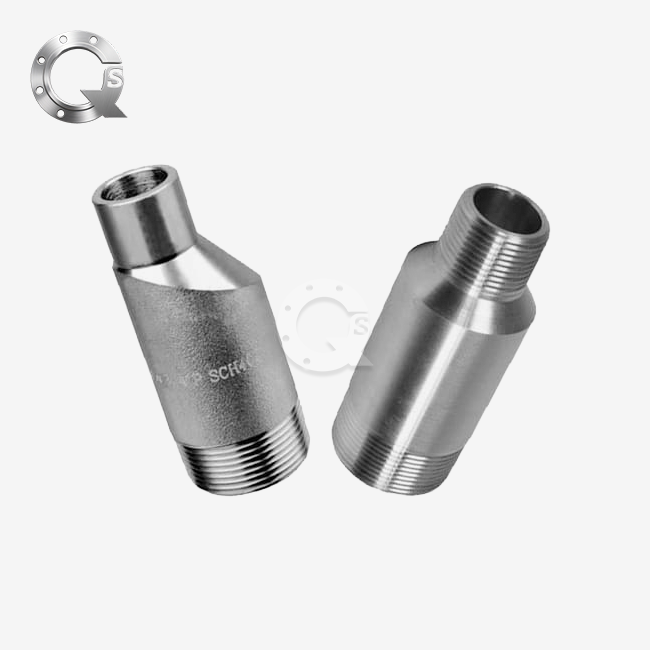
1. Core Definition and Standard Compliance of Swage Nipple MSS SP 95
As a key standard specified fitting, Swage Nipple MSS SP 95 governs the dimensional tolerance, manufacturing process, pressure resistance, and material requirements of swage pipe reducers. This standard covers both concentric and eccentric swage reducers, suitable for threaded and socket weld connection types, and aligns perfectly with ANSI B16.11 and ASME B31 series piping codes. Unlike ordinary pipe nipples, standard-compliant forged swage fittings under this specification feature integrated forging molding, uniform wall thickness, and no internal stress concentration, which effectively avoids leakage and rupture risks under high-pressure working conditions.
Industrial piping systems require standardized fittings to unify design, procurement, and installation specifications. The MSS SP 95 standard clarifies that the allowable working pressure of swage reducers shall be calculated based on seamless straight pipes of the same material and wall thickness, providing a scientific basis for 3000# and 6000# grade classification. All qualified forged pipe nipples manufactured per this standard undergo strict non-destructive testing (NDT) and pressure resistance testing to adapt to harsh industrial operating environments.
2. Fundamental Differences Between 3000# and 6000# Pressure Ratings
Pressure rating is the core parameter determining the service performance of high-pressure swage fittings, directly defining the maximum sustainable working pressure of components under rated temperature conditions. The 3000# and 6000# grades are the most commonly used pressure specifications for standard-compliant swage reducers, with distinct differences in wall thickness, load capacity, and application scenarios.
The 3000# swage nipple is designed for medium-high pressure industrial piping. It features moderate wall thickness, lightweight structure, and cost-effective performance, meeting the pressure demands of most conventional process pipelines. Under standard room temperature conditions, its rated working pressure reaches 3000 PSI, suitable for conventional petrochemical pipelines, water supply and drainage systems, and general industrial fluid transmission projects. For standard-sized pipeline transition with stable pressure fluctuation, the 3000# swage reducer is the most cost-effective choice.
In contrast, the 6000# high-pressure swage nipple adopts an enhanced thick-wall design and optimized forging process. With a rated working pressure of 6000 PSI at room temperature, it doubles the pressure resistance limit of the 3000# grade. This heavy-duty swage fitting boasts higher structural strength, better temperature resistance, and stronger anti-fatigue performance, capable of withstanding extreme working conditions such as high pressure, high temperature, and frequent pressure impact. It is mainly used for high-risk industrial scenarios including high-pressure chemical reaction pipelines, natural gas transmission trunk lines, and power plant high-pressure water supply systems.
In terms of structural parameters, 6000# swage reducers have significantly thicker wall thickness and higher material density than 3000# products of the same nominal diameter. Strictly manufactured per MSS SP 95 dimensional standards, both grades maintain precise end size tolerance to ensure seamless docking with matching pipes, valves, and flanges, avoiding assembly gaps and potential leakage hazards.
3. Key Factors for Matching 3000# and 6000# Swage Nipples with Piping Systems
Reasonable matching of swage nipple pressure grades is the key to ensuring the safe and stable operation of piping systems. Blindly selecting high-grade fittings will increase project costs, while low-grade mismatching will lead to major safety hazards. The matching process needs to comprehensively consider working pressure, operating temperature, pipeline medium, and system design standards.
First, confirm the system’s maximum working pressure. According to MSS SP 95 specification requirements, the rated pressure of the selected fitting must be higher than the system’s peak working pressure, with a 1.2-1.5 times safety margin reserved. For industrial systems with stable pressure below 2500 PSI, 3000# swage reducers can fully meet the operational requirements and control project costs effectively. For systems with peak pressure exceeding 3000 PSI or frequent pressure fluctuations, 6000# high-pressure swage fittings must be selected to eliminate fatigue damage and leakage risks.
Second, consider the operating temperature and medium characteristics. High temperature will reduce the actual pressure resistance of metal fittings. For high-temperature steam pipelines and high-temperature chemical medium transmission systems, even if the nominal working pressure is low, it is recommended to upgrade to 6000# heavy-duty swage reducers to compensate for the temperature-induced strength attenuation. In addition, for corrosive media such as acid, alkali, and salt solutions, matching high-grade stainless steel Swage Nipple MSS SP 95 fittings with thick-wall structures can extend the service life of the piping system.
Third, unify system standard specifications. The pressure grade of swage reducers must be consistent with the supporting pipes, flanges, and valves. Mixed use of different pressure grades will cause uneven system stress and hidden safety troubles. All pipe fittings matching industrial piping systems must strictly follow MSS SP 95 manufacturing standards to ensure consistent dimensional accuracy and pressure resistance of the entire pipeline accessory system.
4. Common Application Scenarios of 3000# and 6000# Standard Swage Fittings
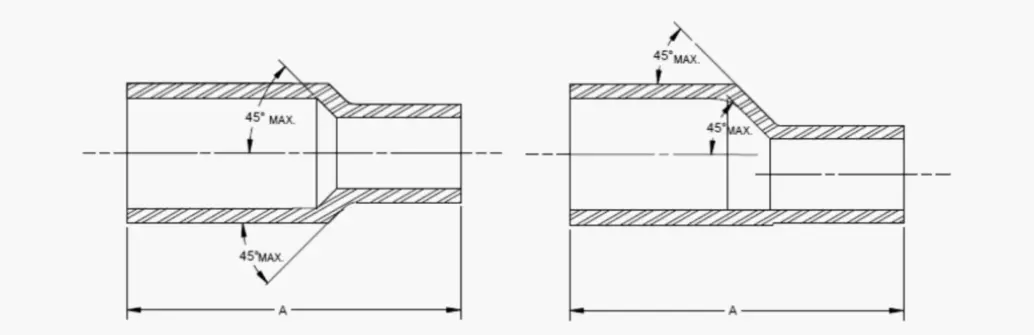
4.1 3000# Swage Nipple Application Scenarios
The 3000# medium-pressure swage reducer is the most widely used specification in general industrial piping projects. With balanced performance and cost advantages, it is suitable for medium and low-pressure fluid transmission systems. Typical application scenarios include conventional petroleum refining auxiliary pipelines, urban industrial water supply and sewage pipelines, low-pressure gas transmission pipelines, and general mechanical equipment supporting piping systems. For factory renovation, pipeline diameter adjustment, and conventional pressure pipeline transition projects, 3000# standard swage fittings can perfectly meet daily operational needs with high cost performance.
4.2 6000# Swage Nipple Application Scenarios
The 6000# high-pressure swage reducer focuses on high-standard and high-risk industrial scenarios, serving core piping systems with strict pressure and safety requirements. It is widely used in petrochemical high-pressure reaction pipelines, natural gas long-distance transmission pipelines, power plant boiler auxiliary high-pressure water and steam pipelines, pharmaceutical high-pressure sterile fluid pipelines, and aerospace supporting industrial piping. In these scenarios, the super-high pressure resistance and structural stability of 6000# swage fittings effectively ensure the zero-leakage and long-term stable operation of the piping system, complying with industry-standard MSS SP 95 and international industrial safety standards.
5. FAQs About Standard Swage Fitting Pressure Grade Matching
Q1: Can 3000# and 6000# swage nipples be mixed in the same piping system?
A1: It is not recommended. Mixed use of different pressure grades will lead to inconsistent pressure resistance and structural strength of pipeline accessories, resulting in uneven system stress. Under working pressure impact, low-grade fittings are prone to priority damage, causing pipeline leakage and safety accidents. It is necessary to unify the pressure grade of all swage nipples and supporting fittings in the same system.
Q2: Does high temperature affect the pressure grade selection of standard swage fittings?
A2: Yes. Metal materials will experience strength attenuation under high-temperature environments, which reduces the actual bearing pressure of swage nipples. For working environments above 300℃, even if the nominal pressure is lower than 3000 PSI, it is recommended to select 6000# high-pressure swage nipples to reserve sufficient safety margin.
Q3: What is the difference between threaded and socket weld standard swage fittings in pressure resistance?
A3: Under the same pressure grade, socket weld swage nipples have better overall pressure resistance and sealing performance, suitable for high-pressure and high-stability requirement scenarios. Threaded swage nipples are easy to install and disassemble, suitable for conventional medium-pressure systems with convenient maintenance needs. Both types strictly follow MSS SP 95 standard specifications.
Q4: How to verify whether a swage fitting complies with industry standard specifications?
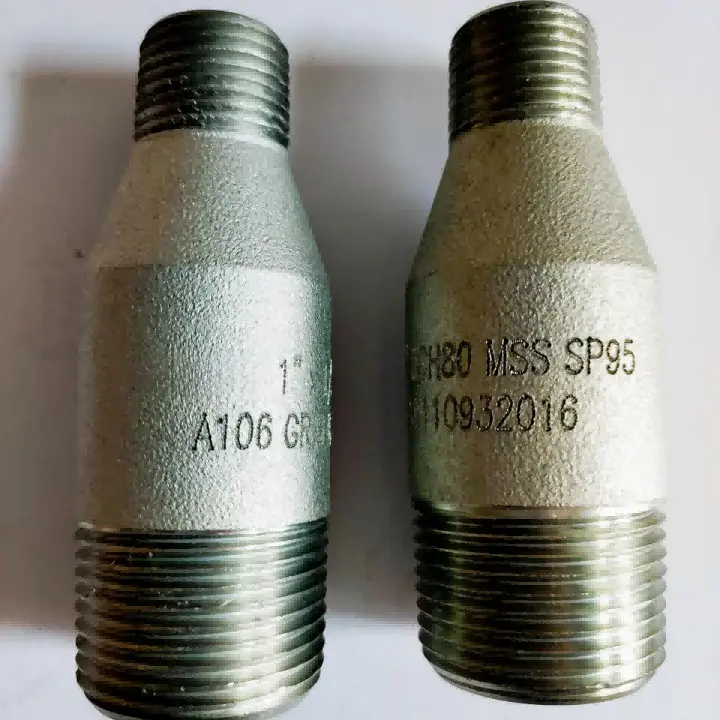
A4: Qualified products shall be marked with standard number, pressure grade, material grade, and dimensional parameters. Meanwhile, manufacturers shall provide factory inspection reports, pressure resistance test reports, and NDT test reports to prove compliance with MSS SP 95 and supporting ANSI/ASME standards.
6. Contact QinSteel for Custom MSS SP 95 Swage Nipple Pressure Matching Solutions
As a professional manufacturer and supplier of high-standard industrial pipe fittings, QinSteel has rich production experience and engineering matching capabilities in Swage Nipple MSS SP 95. We provide one-stop customized solutions covering 3000# and 6000# full-pressure grade swage reducers, supporting carbon steel, stainless steel, alloy steel and multiple material specifications, as well as concentric and eccentric structural customization.
Our products strictly comply with MSS SP 95, ANSI B16.11 and ASME B31 series standards, and undergo full-process quality inspection from raw material procurement to finished product delivery, ensuring stable pressure resistance, precise dimensional tolerance and excellent sealing performance. Whether you need conventional standard products or special customized swage fittings for extreme working conditions, our professional technical team can provide accurate pressure grade matching suggestions according to your piping system parameters, working environment and project requirements.
For product consultation, parameter matching, sample testing and bulk order cooperation, please feel free to contact us via email: info@sxqinsteel.com. We will reply to your inquiry within 24 hours and provide professional industrial piping fitting solutions and competitive factory prices.
7. References
[1] MSS SP-95-2018, Swaged Nipples and Bull Plugs Standard Practice
[2] ANSI B16.11-2009, Forged Steel Fittings, Socket-Welding and Threaded
[3] ASME B31.3-2022, Process Piping Industrial Standard
[4] ASME B31.1-2020, Power Piping Design Specification
[5] Industrial Forged Pipe Fittings Pressure Rating Technical Manual, International Pipe Standard Association
Learn about our latest products and discounts through SMS or email