- English
- French
- German
- Portuguese
- Spanish
- Russian
- Japanese
- Korean
- Arabic
- Greek
- German
- Turkish
- Italian
- Danish
- Romanian
- Indonesian
- Czech
- Afrikaans
- Swedish
- Polish
- Basque
- Catalan
- Esperanto
- Hindi
- Lao
- Albanian
- Amharic
- Armenian
- Azerbaijani
- Belarusian
- Bengali
- Bosnian
- Bulgarian
- Cebuano
- Chichewa
- Corsican
- Croatian
- Dutch
- Estonian
- Filipino
- Finnish
- Frisian
- Galician
- Georgian
- Gujarati
- Haitian
- Hausa
- Hawaiian
- Hebrew
- Hmong
- Hungarian
- Icelandic
- Igbo
- Javanese
- Kannada
- Kazakh
- Khmer
- Kurdish
- Kyrgyz
- Latin
- Latvian
- Lithuanian
- Luxembou..
- Macedonian
- Malagasy
- Malay
- Malayalam
- Maltese
- Maori
- Marathi
- Mongolian
- Burmese
- Nepali
- Norwegian
- Pashto
- Persian
- Punjabi
- Serbian
- Sesotho
- Sinhala
- Slovak
- Slovenian
- Somali
- Samoan
- Scots Gaelic
- Shona
- Sindhi
- Sundanese
- Swahili
- Tajik
- Tamil
- Telugu
- Thai
- Ukrainian
- Urdu
- Uzbek
- Vietnamese
- Welsh
- Xhosa
- Yiddish
- Yoruba
- Zulu
What Manufacturing Methods Are Available for Union MSS SP 83? Is Forging Mandatory for Union MSS SP 83?
Aug 17 2026
Union MSS SP 83 defines specification requirements for socket-welded and threaded steel pipe unions widely adopted in oil-gas, petrochemical, power generation and process piping industries. Many procurement engineers and piping designers hold a common misunderstanding that all union components under this standard must be produced by forging. In fact, MSS SP-83 standard text provides multiple qualified manufacturing routes, while forging remains the most widely-selected production method for heavy-duty high-pressure service. This article sorts out permitted fabrication approaches, clarifies standard clauses, compares process pros-and-cons, and delivers practical guidance for your component selection and technical specification review.
Overview of Union MSS SP 83 Standard Scope
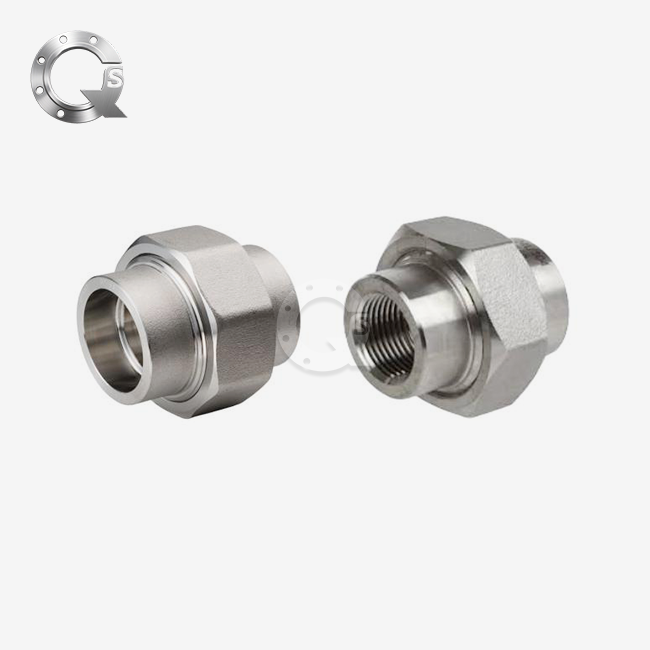
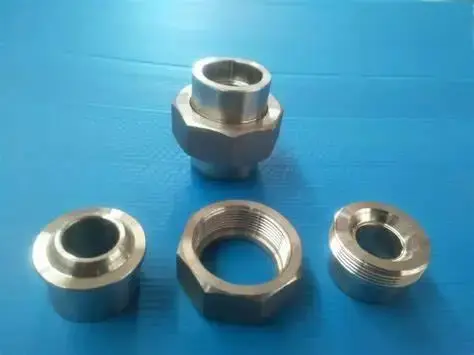
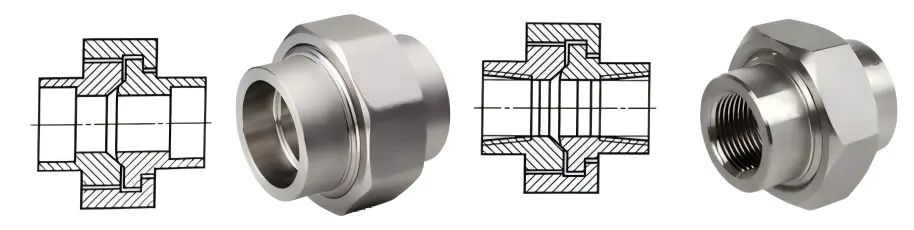
MSS SP 83 Union covers Class 3000 and Class 6000 steel pipe unions in NPS 1/8 through NPS 3, supporting threaded NPT/BSPT ends and socket-weld ends. A complete union assembly consists of three core parts: male seat end, female seat end, and union nut, forming ball-to-cone metal-to-metal sealing interface for quick disassembly and reassembly without cutting pipeline runs.
Raw material grades authorized include carbon steel ASTM A105, low-temperature carbon steel A350 LF2/LF3, alloy steel A182 F11/F22, and stainless steel A182 F304/F316L series. Critical note: all three assembled pieces shall satisfy consistent chemical composition, mechanical property and heat-treatment requirements, with limited exception for stainless union nuts paired with low-carbon stainless end pieces. Many project buyers only focus on pressure class and dimension tables, ignoring manufacturing-method clauses hidden in material chapter, which often triggers non-conformity risks during third-party inspection.
Valid Manufacturing Methods Specified for MSS SP 83 Union
According to clause 6.2 of official MSS SP-83 standard, union parts are permitted to be forged, formed, or machined directly from wrought bar stock, as long as finished components fully meet ASTM material specification mechanical and chemical thresholds. It does not state forging as the only mandatory manufacturing option. Below we break down each qualified production route for MSS-SP-83-compliant pipe unions.
1. Closed-die Forging (Most-Popular Industrial Solution)
Closed-die forging represents the dominant fabrication path for SP 83 Union fittings for high-pressure critical piping. Solid steel billets are heated to forming temperature, compressed inside precision dies to build near-net-shape blanks, followed by heat treatment, shot blasting, multi-axis CNC machining for threads, sealing seats and outer profiles.
Forging refines internal metal grain flow along component geometry, eliminating internal voids and segregation, delivering superior tensile strength, impact toughness and fatigue resistance under cyclic pressure shock. Forged unions perform reliably for Class 3000 / 6000 service in oilfield, refinery and offshore auxiliary piping. Almost all third-party inspection bodies and major end-users such as petrochemical plants prefer forged execution for safety-critical loops.
2. Machining from Solid Wrought Bar
Solid wrought bar machining is another formally permitted manufacturing method within MSS SP-83 scope. Manufacturers start with certified hot-rolled or cold-finished wrought steel round bars, and machine complete union male end, female end and nut directly from bar stock without hot forging deformation.
This process avoids forging-related heating and die-cost investment, suitable for small-batch prototype orders, special non-standard dimensions, or high-alloy material grades where forging die cost is prohibitively high. Engineers must notice one critical point: bar-machined MSS SP 83 Union must strictly satisfy all ASTM wrought-material mechanical test requirements including tensile, hardness and impact test when required by project specification. Simple visual appearance cannot verify material integrity; mill test reports and PMI inspection become essential validation documents.
3. Seamless Forming / Upset Forming
Seamless forming or upset forming falls under the “formed” category written in MSS SP-83 text. Steel bar or seamless tube blank undergoes local hot upsetting to build thickened body sections for union sealing seats and threaded portions, then final-machined to drawing dimensions.
This technique sits between pure bar machining and full closed-die forging. Partial hot forming modifies metal grain structure locally to strengthen high-stress zones. It is less common than closed-die forging, occasionally applied for special alloy small-volume union production. Formed components still need full heat treatment and mechanical property verification to retain MSS SP-83 marking eligibility.
Important Restriction: Casting Is Not Allowed
Casting production is explicitly excluded for Union MSS SP 83. Cast steel contains inherent risks of porosity, shrinkage cavity and grain discontinuity, failing to satisfy wrought-material mechanical requirements defined in MSS SP-83. Any cast union cannot bear official SP-83 marking, even if outer dimensions match standard tables. Purchasers should stay alert against low-cost counterfeit cast products circulating in the market.
Is Forging Mandatory for MSS SP 83? Technical Clarification
Reading the standard literally, MSS SP-83 does not impose absolute mandatory forging requirement for union components. Three acceptable manufacturing paths: forging, wrought-bar machining, seamless forming are all documented in clause 6.2.
Nevertheless, real-world engineering practice creates widespread impression that “MSS SP-83 unions should be forged”. There are two major reasons for this industry consensus:
First, most end-user project specifications add extra constraints beyond minimum MSS SP-83 baseline requirements. Many refinery, natural-gas and EPC project data sheets explicitly write “all union components shall be closed-die forged”, overriding standard default multi-option permission. In such project scenarios, bar-machined unions become non-compliant regardless of satisfying MSS SP-83 minimum rules.
Second, mechanical-performance gap exists between different manufacturing routes. Forged blanks deliver optimized continuous grain flow, far better anti-shock and anti-leak performance under pressure fluctuation, thermal cycling and vibration conditions. Bar-machined parts keep original bar grain orientation without hot deformation reshaping; they can pass lab static pressure test yet carry higher potential risk under harsh cyclic working environments.
Piping engineers must distinguish two different concepts: minimum standard requirement vs. project-specific additional specification. If your purchase order only references MSS SP-83 without extra forging clause, qualified bar-machined unions are technically acceptable; if project specification adds “forged only” constraint, you must select closed-die forged Union SP 83 to avoid inspection rejection.
Key Comparison Between Forged and Bar-Machined Union MSS SP 83
|
Evaluation Item |
Closed-die Forged Union |
Wrought-Bar Machined Union |
|
Standard Compliance |
Complies with MSS SP-83 |
Complies with MSS SP-83 (when material test passed) |
|
Metal Grain Structure |
Grain flows follow fitting contour, high toughness |
Original bar grain without deformation reshaping |
|
Suitable Scenarios |
High-pressure, vibration, cyclic pressure critical loops |
Small-batch prototype, static low-stress auxiliary piping |
|
Cost Level |
Medium-high, higher die investment |
Lower for small-batch orders |
|
Market Supply |
Mass stock available from mainstream fittings manufacturers |
Mostly custom-manufactured upon request |
|
Project-Spec Risk |
Matches most EPC project additional requirements |
Risk of rejection if project requires forging explicitly |
When you prepare technical bid documents or material requisition forms, clearly write down manufacturing method requirement. Simply quoting “Union MSS SP 83” leaves manufacturing-method ambiguity, which may cause suppliers to deliver bar-machined goods while you expect forged execution. Explicitly adding “components shall be closed-die forged” eliminates this commercial-technical gap.
Practical Procurement & Specification Writing Tips for Union MSS SP 83
1. Cross-check project specification priority. Client-project-specific requirements prevail over MSS SP-83 minimum baseline rules. Always confirm whether “forged only” clause exists in data sheet before releasing RFQ.
2. Request complete mill test reports. Whether forged or bar-machined, MTC shall cover chemical composition, mechanical test results, heat-treatment records and material grade traceability.
3. Reject cast-body substitutes. If physical inspection finds casting-gate marks, porosity on surface, reject goods even dimensions look correct.
4. Pay attention to assembly compatibility. MSS SP-83 reminds users not to mix union parts originating from different manufacturers; seat-surface geometry subtle differences may induce leakage risk after assembly.
5. Define marking requirement clearly. Qualified products shall be permanently marked with MSS SP-83, pressure class, material grade, size and manufacturer trademark. Products without legal SP-83 marking cannot be accepted, even if dimensions match.
FAQs
Q1: If union is machined from wrought bar, can it still be marked MSS SP-83?
A1: Yes. On condition that raw material meets corresponding ASTM wrought-material specification, all mechanical and chemical indexes pass testing, finished dimensions and tolerances comply with MSS SP-83 tables, legal SP-83 marking is permitted per standard text. But you still need to check if your client project bans bar-machined construction.
Q2: Can I use cast union with same dimension as replacement for MSS SP 83 Union ?
A2: No. Cast products do not satisfy wrought-material requirement, and shall never carry MSS SP-83 marking. Cast union is not acceptable for pressure-bearing piping service under this standard.
Q3: For Class 6000 high-pressure MSS SP 83 Union , is forging mandatory?
A3: From pure MSS SP-83 standard text, forging is still not absolutely mandatory. However nearly all industrial Class 6000 high-pressure projects will specify closed-die forging as mandatory requirement for safety consideration. It is strongly recommended to adopt forged execution for Class 6000 working condition.
Q4: What risk will happen if bar-machined union is applied for vibration-intensive pipeline?
A4: Under long-term vibration and cyclic pressure, bar-machined union may generate hidden stress risk at high-stress transition zones. Though static hydro-test can pass, long-term service leakage or cracking risk increases, so not recommended for critical vibration-heavy loops.
Q5: What documents should I ask suppliers to provide for verifying MSS SP 83 manufacturing method?
A5: Request mill test report, heat-treatment record, manufacturing procedure description. For forged items, you can also ask for forging-process record. Visual appearance alone cannot reliably distinguish bar-machined vs forged fittings.
Contact QinSteel for Reliable Union MSS SP 83 Piping Component Solutions
Whether you need closed-die forged Union MSS SP 83 for critical high-pressure process lines, or custom special-material bar-machined union products for prototype projects, QinSteel delivers full-scope piping fitting solutions complying with MSS SP-83, ASME B16.11 and related industrial standards. Our product portfolio covers NPS 1/8-3 threaded and socket-weld unions in carbon steel, stainless steel, alloy steel grades, with complete MTC documentation, third-party inspection support available upon client request.
Send your RFQ, technical specification sheets or project inquiries to our official business email: info@sxqinsteel.com. Our technical-sales team will review your technical requirements, clarify manufacturing-method constraints, and provide formal quotation with clear manufacturing-process declaration to avoid technical ambiguity and non-conformity risks for your procurement.
References
1. Manufacturers Standardization Society. MSS SP-83-2025, Standard Practice for Class 3000 and 6000 Steel Pipe Unions, Socket-Welding and Threaded[S]. MSS, 2025.
2. ASTM A105/A105M-24, Standard Specification for Carbon-Steel Forgings for Piping Applications[S]. ASTM International.
3. ASTM A182/A182M-25, Standard Specification for Forged or Rolled Alloy and Stainless-Steel Pipe Flanges, Forged Fittings, and Valves and Parts for High-Temperature Service[S]. ASTM International.
4. MSS SP-83 Material & Manufacturing Clause Interpretation, Piping Engineering Technical Guideline, Piping-Material Database Technical Document, 2024.
5. ASME B16.11-2021, Forged Fittings, Socket-Welding and Threaded[S]. ASME.
Learn about our latest products and discounts through SMS or email