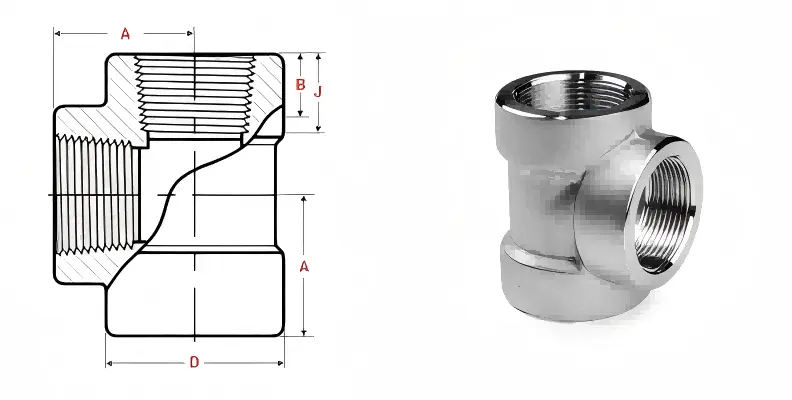
The strings of ASME B16.11 threaded tees are outstandingly exact, ordinarily accomplishing a resilience level of ±0.015 inches for NPT strings. This high level of accuracy guarantees a tight, leak-proof seal in channeling frameworks. The threading process follows strict ASME guidelines, utilizing progressed CNC equipment to cut threads with exceptional accuracy. This accuracy is pivotal for keeping up the astuteness of high-pressure frameworks in different businesses, including oil and gas, where even minor spills can lead to noteworthy security dangers and effectiveness losses. The correct resiliences may shift marginally depending on the particular estimate and fabric of the tee, but all ASME B16.11 threaded tees are fabricated to meet or surpass industry measures for string precision.
Understanding ASME B16.11 Threaded Tees and Their Significance
What are ASME B16.11 Threaded Tees?
ASME B16.11 threaded tees are fundamental components in channeling frameworks, designed to encourage the association of three channels at right angles. These fittings are fabricated according to the strict measures set by the American Society of Mechanical Engineers (ASME), particularly the B16.11 detail. This standard guarantees consistency, unwavering quality, and tradable over diverse producers and applications.
Threaded tees include precision-cut NPT (National Pipe Thread) or BSP (British Standard Pipe) threads, which permit secure, leak-tight associations without the requirement for welding. The threading handle is a basic viewpoint of their generation, straightforwardly affecting the fitting's execution and life span in service.
The Importance of Thread Precision in Piping Systems
Thread accuracy in ASME B16.11 threaded tees is of foremost significance for a few reasons:
- Leak Avoidance: Exact strings guarantee a tight seal between the tee and the interfacing channels, minimizing the hazard of spills even under high pressure.
- Structural Judgment: Exact threading contributes to the overall quality and strength of the channeling framework, decreasing the probability of disappointments or breakages.
- Ease of Get together: Well-cut strings permit for smoother establishment and dismantling, sparing time and decreasing the chance of harm during maintenance.
- Compatibility: Exact strings guarantee that fittings from diverse producers can be utilized traded, giving adaptability in framework plan and maintenance.
Applications of ASME B16.11 Threaded Tees
ASME B16.11 threaded tees discover wide-ranging applications across different businesses due to their unwavering quality and flexibility. A few common employments include:
- Oil and gas pipelines
- Chemical handling plants
- Power era facilities
- Water treatment systems
- HVAC installations
- Industrial machinery
The accuracy of the strings in these tees is pivotal for keeping up the astuteness and security of these frequently basic systems.
The Manufacturing Process and Quality Control Measures
Thread Cutting Techniques for ASME B16.11 Tees
The fabrication process of ASME B16.11 threaded tees includes a few advanced steps to guarantee string precision:
- Material Choice: High-quality materials such as stainless steel, carbon steel, or amalgam steel are chosen based on the aiming application.
- Forging or Casting: The essential shape of the tee is shaped through forging or cast.
- CNC Machining: Computer Numerical Control (CNC) machines are utilized to cut the strings with high accuracy. These machines can accomplish exceptionally tight resiliences, regularly inside ±0.015 inches for NPT threads.
- Thread Profile Cutting: The particular string profile (NPT or BSP) is cut according to the required details. This preparation is carefully controlled to guarantee the adjusted string pitch, point, and depth.
- Surface Wrapping up: The threaded surfaces are frequently treated or coated to upgrade erosion resistance and make strides in fixing properties.
Quality Control and Inspection Procedures
To keep up the high accuracy of ASME B16.11 threaded tees, thorough quality control measures are implemented:
- Dimensional Review: Each tee is measured to guarantee it meets the indicated measurements, including string depth, pitch, and generally size.
- Thread Gage Testing: Specialized gages are utilized to confirm the precision of the string profile and guarantee it meets ASME standards.
- Pressure Testing: Tees are regularly subjected to hydrostatic or pneumatic tests to confirm their capacity to withstand working weights without leaks.
- Material Composition Investigation: Standard checks are performed to affirm that the fabric meets the required chemical and physical properties.
- Surface Wrap-up Assessment: The quality of the string surface is inspected to guarantee smoothness and the absence of imperfections that might compromise sealing.
Factors Affecting Thread Precision
Several variables can impact the exactness of strings in ASME B16.11 tees:
- Machine Calibration: The precision of CNC machines and their normal calibration straightforwardly affect string precision.
- Tool Wear: Cutting apparatuses must be routinely reviewed and replaced to keep up reliable string quality.
- Material Properties: The hardness and machinability of the chosen fabric can influence the threading process.
- Temperature Control: Keeping up a steady temperature during manufacturing makes a difference in avoiding warm development issues that seem to influence precision.
- Operator Ability: Despite mechanization, the ability and attention to detail of machine administrators play a vital part in accomplishing high precision.
Ensuring Compliance and Performance in Field Applications
Standards and Certifications for ASME B16.11 Threaded Tees
ASME B16.11 threaded tees must comply with different measures and certifications to guarantee their quality and reliability:
- ASME B16.11 Standard: This is the essential standard that directs the measurements, dimensions, and materials for fashioned fittings, including threaded tees.
- ASME B1.20.1: This standard particularly covers the measurements and resistances for NPT threads.
- ISO 7-1: For BSP strings, this universal standard is regularly referenced.
- API 598: This standard from the American Petroleum Institute covers valve review and testing, which is regularly connected to threaded tees as well.
- PED (Weight Hardware Order): In Europe, compliance with PED is regularly required for pressure-bearing components like threaded tees.
Manufacturers frequently look for certifications such as ISO 9001 for quality administration frameworks to illustrate their commitment to creating high-precision components consistently.
Installation Best Practices for Optimal Performance
To guarantee the accuracy of ASME B16.11 threaded tees interpreted into ideal execution in the field, proper installation is crucial:
- Thread Planning: Clean strings altogether and apply fitting string sealant or tape.
- Proper Arrangement: Guarantee channels are accurately adjusted some time recently interfacing to the tee to anticipate push on the threads.
- Torque Control: Utilize calibrated torques to accomplish the adjustment fixing constraint, maintaining a distance from over-tightening, which can harm threads.
- Temperature Contemplations: Account for warm development in the framework plan and establishment process.
- Corrosion Security: Apply protective coatings or medicines to secure strings from erosion in harsh environments.
Maintenance and Inspection in Service
Regular upkeep and assessment are basic to protect the judgment of threaded connections:
- Periodic Assessments: Frequently check for signs of spillage, erosion, or string damage.
- Re-tightening: Occasionally confirm and alter the snugness of associations, particularly in frameworks subject to vibration or warm cycling.
- Thread Cleaning: When dismantling for upkeep, clean strings carefully and assess for wear or harm. Some time recently reassembled.
- Replacement Plan: Actualize a proactive substitution plan for basic components based on benefit conditions and anticipated lifespan.
- Documentation: Keep up-to-date point-by-point records of establishment, upkeep, and any issues experienced to educate future decision-making and make strides toward framework reliability.
Conclusion
The exactness of strings in ASME B16.11 threaded tees is a basic calculation in guaranteeing the unwavering quality, security, and productivity of channeling frameworks over different businesses. With resiliences ordinarily inside ±0.015 inches for NPT strings, these components offer remarkable fixing capabilities and auxiliary judgment. The combination of progressed fabrication procedures, exacting quality control measures, and adherence to worldwide guidelines results in threaded tees that meet the requesting necessities of advanced mechanical applications. By understanding the significance of string exactness and following best practices in installation and support, engineers and professionals can maximize the execution and life span of frameworks utilizing ASME B16.11 threaded tees.
FAQs
What materials are commonly used for ASME B16.11 threaded tees?
Common materials include stainless steel, carbon steel, and various alloy steels, chosen based on the specific application requirements.
How often should ASME B16.11 threaded tees be inspected?
Inspection frequency depends on the application, but generally, annual inspections are recommended, with more frequent checks in critical or harsh environments.
Can ASME B16.11 threaded tees be used in high-pressure systems?
Yes, these tees are designed for use in high-pressure applications, but the specific pressure rating depends on the material and size of the tee.
Expert ASME B16.11 Threaded Tee Solutions | QinSteel
At QinSteel, we specialize in manufacturing high-precision ASME B16.11 threaded tees that meet the most stringent industry standards. As a leading supplier and manufacturer, we offer a wide range of sizes and materials to suit diverse applications. Our state-of-the-art production facilities and rigorous quality control ensure unparalleled thread precision and product reliability. For expert advice or to discuss your specific requirements, contact us at info@sxqinsteel.com.

References
American Society of Mechanical Engineers. (2017). ASME B16.11-2016: Forged Fittings, Socket-Welding and Threaded. New York: ASME.
Nayyar, M. L. (2000). Piping Handbook (7th ed.). McGraw-Hill Education.
American Petroleum Institute. (2016). API Specification 598: Valve Inspection and Testing (10th ed.). Washington, D.C.: API Publishing Services.
International Organization for Standardization. (2000). ISO 7-1:1994 Pipe threads where pressure-tight joints are made on the threads — Part 1: Dimensions, tolerances and designation. Geneva: ISO.
Smith, P. (2005). Piping Materials Guide: Selection and Applications. Elsevier Science.
Antaki, G. A. (2003). Piping and Pipeline Engineering: Design, Construction, Maintenance, Integrity, and Repair. CRC Press.