- English
- French
- German
- Portuguese
- Spanish
- Russian
- Japanese
- Korean
- Arabic
- Greek
- German
- Turkish
- Italian
- Danish
- Romanian
- Indonesian
- Czech
- Afrikaans
- Swedish
- Polish
- Basque
- Catalan
- Esperanto
- Hindi
- Lao
- Albanian
- Amharic
- Armenian
- Azerbaijani
- Belarusian
- Bengali
- Bosnian
- Bulgarian
- Cebuano
- Chichewa
- Corsican
- Croatian
- Dutch
- Estonian
- Filipino
- Finnish
- Frisian
- Galician
- Georgian
- Gujarati
- Haitian
- Hausa
- Hawaiian
- Hebrew
- Hmong
- Hungarian
- Icelandic
- Igbo
- Javanese
- Kannada
- Kazakh
- Khmer
- Kurdish
- Kyrgyz
- Latin
- Latvian
- Lithuanian
- Luxembou..
- Macedonian
- Malagasy
- Malay
- Malayalam
- Maltese
- Maori
- Marathi
- Mongolian
- Burmese
- Nepali
- Norwegian
- Pashto
- Persian
- Punjabi
- Serbian
- Sesotho
- Sinhala
- Slovak
- Slovenian
- Somali
- Samoan
- Scots Gaelic
- Shona
- Sindhi
- Sundanese
- Swahili
- Tajik
- Tamil
- Telugu
- Thai
- Ukrainian
- Urdu
- Uzbek
- Vietnamese
- Welsh
- Xhosa
- Yiddish
- Yoruba
- Zulu
ASME B16.11 Full Coupling: Material Selection Guide for Carbon, Stainless and Duplex Steel
Aug 12 2026
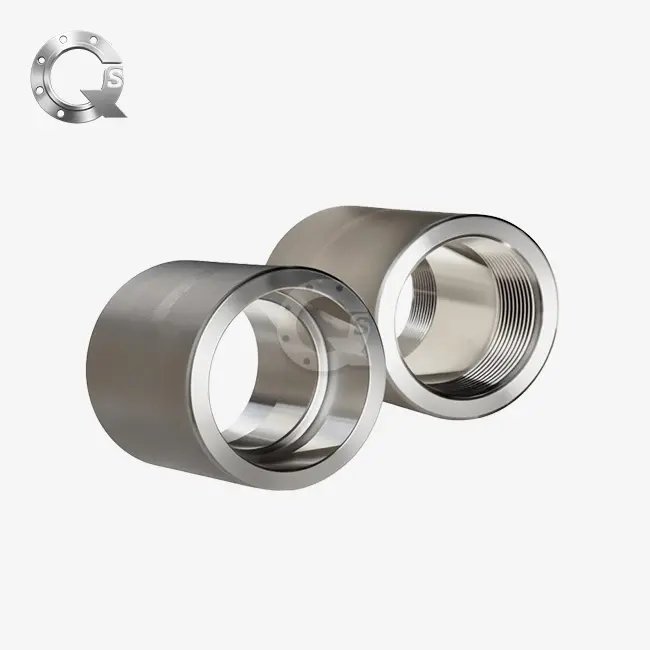
ASME B16.11 Full Coupling is a critical forged pipe fitting widely used in high-pressure, small-bore piping systems across oil and gas, chemical, power generation, and marine industries. As a standardized component compliant with ASME B16.11 industrial specifications, it features full-length integrated forging, stable pressure resistance, and reliable pipeline connection performance. Selecting the right material for this coupling is essential to ensure long-term operational stability, safety, and cost-effectiveness of industrial piping systems. This article elaborates on the applicable scenarios, performance advantages, and selection principles of carbon steel, stainless steel, and duplex stainless steel for standard forged couplings, providing professional reference for industrial pipeline design and procurement.
Fundamental Introduction to ASME B16.11 Full Coupling
ASME B16.11 is the core American standard governing forged socket-weld and threaded pipe fittings, covering dimensional tolerances, pressure-temperature ratings, material specifications, and marking requirements for industrial couplings, elbows, tees, and other fittings. This standardized full coupling adopts an integral forging process without welding seams, effectively avoiding leakage risks caused by welding defects. It is available in three mainstream pressure classes: 3000LB, 6000LB, and 9000LB, adapting to different high-pressure industrial working conditions.
Unlike half couplings that only connect single-ended pipelines, full-style forged couplings realize double-ended equal-diameter pipeline connection, which is mainly used for straight pipe extension, broken pipe maintenance, and fixed-diameter pipeline transition in industrial piping. Its compact structure, high mechanical strength, and strong pressure resistance make it irreplaceable in small-bore auxiliary piping, instrument piping, and high-pressure process piping systems. Material selection directly determines the service life, corrosion resistance, and temperature resistance of the fitting, so targeted material matching according to working conditions is the core of pipeline system optimization design.
Applicable Working Conditions of Carbon Steel ASME B16.11 Full Coupling
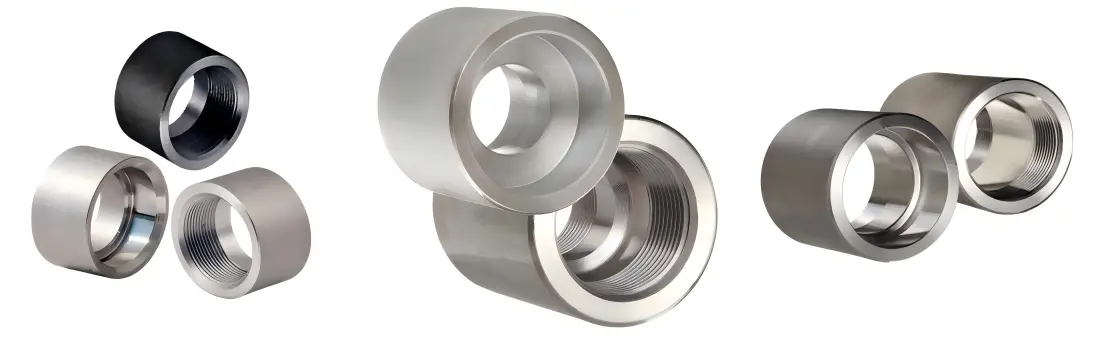
Carbon steel is the most cost-effective and widely used material for B16.11 full coupling products, with ASTM A105 and ASTM A350 LF2 as the mainstream grades in industrial applications. This type of coupling is characterized by high mechanical strength, good forgeability, low production cost, and stable performance under conventional high-pressure and high-temperature conditions, making it the preferred choice for general industrial piping systems.
Carbon steel forged full couplings are mainly applicable to conventional working conditions without strong corrosive media. First, it is suitable for conventional steam piping, oil and gas transmission piping, and industrial water circulation systems in thermal power plants, petrochemical plants, and municipal engineering. Its maximum applicable temperature can reach 400°C, and it can stably withstand the pressure load of 3000LB to 9000LB pressure-grade pipelines, fully meeting the operation requirements of conventional industrial medium transmission.
Second, low-temperature carbon steel (ASTM A350 LF2) full couplings are suitable for low-temperature service environments above -46°C, such as low-temperature gas transmission pipelines and cold storage industrial piping. It effectively avoids the brittle fracture problem of ordinary carbon steel at low temperatures and ensures the structural stability of the coupling in low-pressure and low-temperature working conditions. In addition, carbon steel fittings are widely used in fire protection piping, hydraulic equipment auxiliary piping, and conventional mechanical equipment piping connections, with outstanding cost performance and easy processing and installation.
It is worth noting that carbon steel fittings have obvious limitations: poor corrosion resistance. They are not suitable for acidic, alkaline, chloride-containing, and humid marine corrosive environments. Long-term use in corrosive media will lead to oxidation, rust, and wall thickness thinning, resulting in pipeline leakage and safety hazards. Therefore, carbon steel B16.11 forged couplings are only recommended for non-corrosive conventional industrial working conditions.
Applicable Working Conditions of Stainless Steel ASME B16.11 Full Coupling
Stainless steel forged couplings mainly adopt ASTM A182 F304 and F316 grades, which make up for the corrosion resistance defects of carbon steel couplings and are widely used in medium-corrosion industrial environments. Compared with carbon steel, stainless steel materials have excellent oxidation resistance, acid and alkali corrosion resistance, and smooth inner wall, which can prevent medium contamination and reduce pipeline fluid resistance.
F304 stainless steel full-style fittings are suitable for general corrosive working conditions, including food processing, pharmaceutical production, daily chemical industry, and atmospheric corrosion industrial piping. Its excellent rust resistance can ensure the cleanliness of the transmission medium, avoid secondary pollution of materials, and meet the hygienic production standards of food and pharmaceutical industries. It is also applicable to indoor chemical water treatment systems and low-concentration salt water transmission pipelines with mild corrosion.
F316 stainless steel is an upgraded version of 304 stainless steel, with added molybdenum element, which significantly improves its resistance to chloride ion corrosion and high-temperature oxidation. The F316 stainless steel B16.11 full coupling is suitable for moderately corrosive environments such as coastal humid environments, low-concentration acid-base solution transmission, and industrial wastewater treatment systems. It can also operate stably in high-temperature corrosive flue gas auxiliary piping and chemical process piping with complex medium components.
The service temperature range of stainless steel full fittings is wider than that of carbon steel, which can adapt to long-term operation in high-temperature corrosive environments below 450°C. However, stainless steel also has certain limitations: it is prone to stress corrosion cracking in high-concentration chloride and high-temperature alternating load environments, and its mechanical strength under ultra-high pressure is slightly lower than that of duplex stainless steel, so it is not suitable for extreme harsh corrosive working conditions.
Applicable Working Conditions of Duplex Stainless Steel ASME B16.11 Full Coupling
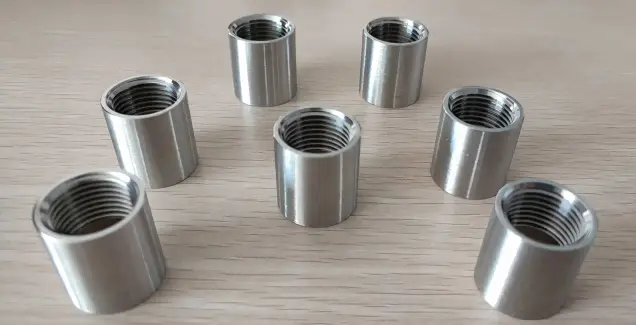
Duplex stainless steel represented by ASTM A182 F51 (2205) is a high-performance material for ASME B16.11 Full Coupling, which integrates the advantages of ferritic stainless steel and austenitic stainless steel. It has ultra-high mechanical strength, excellent chloride stress corrosion resistance, and pitting corrosion resistance, and is the optimal choice for extreme harsh industrial working conditions.
Duplex stainless steel full fittings are mainly applicable to high-corrosion and high-pressure working conditions that carbon steel and ordinary stainless steel cannot adapt to. First, they are widely used in offshore oil and gas platforms, seawater desalination systems, and marine engineering piping. Seawater contains a large amount of chloride ions, which can easily cause pitting corrosion and stress corrosion of ordinary stainless steel, while duplex stainless steel can effectively resist seawater corrosion and maintain long-term stable operation in marine environments.
Second, this high-performance coupling fitting is suitable for high-corrosion chemical process systems, such as high-concentration acid-base solution transmission, chemical reaction kettle auxiliary piping, and petrochemical hydrocarbon medium treatment piping. Its pitting resistance and crevice corrosion resistance are far superior to 304 and 316 stainless steel, and it can withstand complex corrosive media and high-pressure alternating loads. In addition, duplex stainless steel has good low-temperature toughness and high-temperature stability, and can adapt to variable temperature and pressure working conditions in industrial production.
Although duplex stainless steel has excellent comprehensive performance, its production cost is high, and the processing and forging process is more complex. Therefore, it is not recommended to replace carbon steel and ordinary stainless steel couplings in conventional working conditions. It is only targeted for extreme harsh working conditions with high corrosion, high pressure, and high reliability requirements, which can balance service life and comprehensive economic benefits.
Performance and Application Comparison of Three Material Types
To simplify the material selection of standard B16.11 full fittings for different working conditions, the core performance and applicable scenarios of the three mainstream materials are summarized as follows. Carbon steel (A105/A350 LF2) is suitable for conventional non-corrosive, high-pressure and conventional temperature working conditions, with the lowest cost and the widest conventional application range, applicable to power, municipal, and ordinary petrochemical industries. Stainless steel (F304/F316) is suitable for mild and moderate corrosive, hygienic and clean working conditions, balancing corrosion resistance and cost, applicable to food, pharmaceutical, and general chemical industries.
Duplex stainless steel (F51 2205) is suitable for high-corrosion, chloride-rich, high-pressure extreme working conditions, with the highest comprehensive performance but higher cost, mainly used in offshore engineering, marine chemical industry, and high-corrosion industrial scenarios. In actual pipeline design and procurement, enterprises need to comprehensively consider medium characteristics, temperature, pressure, service life requirements, and project budget to select the most matching coupling material, avoiding safety hazards caused by material mismatch or cost waste caused by over-matching.
Frequently Asked Questions
Q1: What is the core difference between full coupling and half coupling under ASME B16.11 standard?
A1: The core difference lies in the connection form and application scenario. Standard full-style coupling adopts double-ended equal-diameter connection, used for straight pipe extension and broken pipe repair of equal-diameter pipelines; half coupling is single-ended connection, mainly used for branch pipe connection of main pipelines. Full-style fittings have higher overall structural integrity and pressure resistance, suitable for high-pressure main pipeline connection.
Q2: Can stainless steel couplings replace carbon steel couplings in all conventional working conditions?
A2: Technically, stainless steel can adapt to conventional working conditions of carbon steel, but it will cause unnecessary cost waste. Carbon steel fittings have higher mechanical hardness and lower cost in non-corrosive environments, which is more in line with the economic principle of industrial pipeline construction. It is not recommended to replace carbon steel with stainless steel in conventional working conditions.
Q3: What is the service life difference between the three materials in marine environments?
A3: Carbon steel fittings are prone to rapid rust and corrosion in marine chloride environments, with a service life of only 1-3 years; ordinary 316 stainless steel fittings have moderate corrosion resistance, with a service life of 5-8 years; duplex stainless steel fittings can resist seawater pitting and stress corrosion, with a service life of more than 15 years, which is the most suitable material for marine engineering.
Q4: What pressure grades are available for standard ASME B16.11 Full Coupling?
A4: The standard full coupling covers three mainstream pressure grades: 3000LB, 6000LB, and 9000LB, adapting to low, medium, and high-pressure industrial piping systems. All products comply with ASME B16.11 pressure-temperature rating standards, with stable pressure resistance and no leakage under rated working conditions.
Contact QinSteel for Customized ASME B16.11 Full Coupling Solutions
QinSteel is a professional manufacturer and supplier of ASME standard forged pipe fittings, focusing on the R&D, production, and customization of high-quality full couplings, half couplings, flanges, and other pipeline accessories. The company has advanced forging production lines and complete quality testing systems, and all standard full coupling products strictly comply with ASME standards and ASTM material specifications, with complete material test reports and factory certification documents.
We can provide carbon steel, stainless steel, duplex stainless steel full fittings of various pressure grades and specifications, support non-standard size customization, surface anti-corrosion treatment, and one-stop pipeline fitting matching services. Our products are widely exported to Europe, America, Southeast Asia, the Middle East, and other regions, serving petrochemical, offshore engineering, power generation, and chemical industry customers worldwide. For product consultation, parameter customization, sample testing, and bulk procurement quotations, please contact our professional customer service team via email: info@sxqinsteel.com. We will provide you with accurate material selection guidance, professional technical solutions, and cost-effective product services within 24 hours.

Technical References
[1] ASME B16.11-2021, Forged Socket Welding and Threaded Fittings Standard
[2] ASTM A105/A105M-20, Standard Specification for Carbon Steel Forgings for Piping Applications
[3] ASTM A182/A182M-24, Standard Specification for Forged Stainless Steel and Alloy Steel Pipe Flanges, Forged Fittings, and Valves and Parts for High-Temperature Service
[4] ASTM A350/A350M-22, Standard Specification for Carbon Steel and Low-Alloy Steel Forgings for Low-Temperature Piping Components
[5] Industrial Piping Material Selection and Corrosion Resistance Design Manual, Chemical Industry Press
Learn about our latest products and discounts through SMS or email