- English
- French
- German
- Portuguese
- Spanish
- Russian
- Japanese
- Korean
- Arabic
- Greek
- German
- Turkish
- Italian
- Danish
- Romanian
- Indonesian
- Czech
- Afrikaans
- Swedish
- Polish
- Basque
- Catalan
- Esperanto
- Hindi
- Lao
- Albanian
- Amharic
- Armenian
- Azerbaijani
- Belarusian
- Bengali
- Bosnian
- Bulgarian
- Cebuano
- Chichewa
- Corsican
- Croatian
- Dutch
- Estonian
- Filipino
- Finnish
- Frisian
- Galician
- Georgian
- Gujarati
- Haitian
- Hausa
- Hawaiian
- Hebrew
- Hmong
- Hungarian
- Icelandic
- Igbo
- Javanese
- Kannada
- Kazakh
- Khmer
- Kurdish
- Kyrgyz
- Latin
- Latvian
- Lithuanian
- Luxembou..
- Macedonian
- Malagasy
- Malay
- Malayalam
- Maltese
- Maori
- Marathi
- Mongolian
- Burmese
- Nepali
- Norwegian
- Pashto
- Persian
- Punjabi
- Serbian
- Sesotho
- Sinhala
- Slovak
- Slovenian
- Somali
- Samoan
- Scots Gaelic
- Shona
- Sindhi
- Sundanese
- Swahili
- Tajik
- Tamil
- Telugu
- Thai
- Ukrainian
- Urdu
- Uzbek
- Vietnamese
- Welsh
- Xhosa
- Yiddish
- Yoruba
- Zulu
What Is a 180Deg Elbow and Where Does It Belong in a Piping System?
Oct 14 2026
A 180Deg Elbow turns a line through a full half circle, so the fluid that enters one end leaves the other travelling straight back the way it came. It is one fitting rather than two welded bends, and that single fact drives the take-out, the number of welds a fabricator has to qualify and the space the loop occupies. This article covers what the fitting is, how ASME B16.9 dimensions it, the two radii sold as standard, and the services where a return bend is the right answer rather than a habit.
What a Return Bend Actually Does
A 180Deg Elbow is a U shaped fitting with both ends facing the same direction and lying in the same plane. Fluid enters one end, is carried around a half circle and leaves the other on a parallel centreline, so the line reverses without a fabricated loop of pipe and the two extra welds that a loop would need.
The two end faces being coplanar is what separates a genuine return bend from two 90 degree elbows welded together. That coplanarity is not cosmetic. A return bend that is twisted will pull the run out of alignment when it is offered up to a manifold or a coil support, and a fitter will correct the twist by force rather than by measurement, which is how a good fitting acquires a bad reputation.
The fitting is made to ASME B16.9 in the same standard as elbows, tees and reducers, so the material grades, the bevel preparation and the marking rules that a buyer already knows from the rest of the bill of materials carry straight across to it.
One Fitting, Not Two Welded Elbows
The obvious alternative is two 90 degree elbows cut and welded together, and on some jobs that is genuinely cheaper. A fabricated U brings four girth welds instead of two, needs a spool piece between the elbows and consumes more straight pipe, but it lets a fabricator build a bend whose radius matches whatever the pipe rack will allow.
A 180Deg Elbow wins wherever the weld count matters: sour service, cyclic duty, high pressure or anywhere radiography is specified. Two welds that must be made, examined and accepted cost more than the price difference on the fitting. We quote both routes when a customer asks, because the answer usually turns on the examination budget rather than on the part price.
Long Radius and Short Radius in the Same Standard
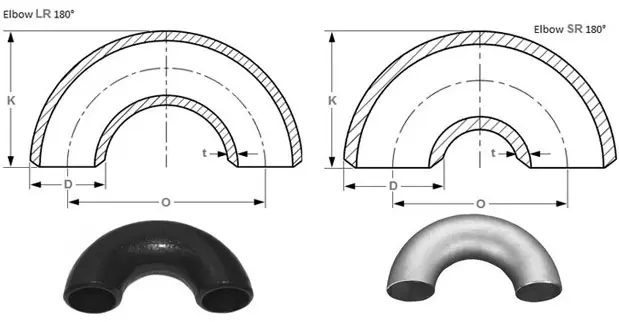
A 180Deg Elbow is made in two radii. Long radius has a centreline radius of one and a half times the nominal pipe size and short radius is one times the nominal size. The centre-to-centre distance doubles with it, so an NPS 4 return measures 305 mm across in long radius and 203 mm in short radius.
Short radius is the space saver and also the harder fitting to weld, because the tighter sweep crowds the two bevels and leaves less room for a torch between the ends. Long radius is the default in process piping and the pattern most often carried in stock; short radius is normally a mill order with a longer lead time.
How the Fitting Is Dimensioned
Two figures describe a 180Deg Elbow: O is the centre-to-centre distance between the and K is the back-to-face distance measured from the outside of the U to the face of the outlet. Together they let a draughtsman set out the loop without guessing at the centreline.
Both are derived from the radius. O is twice the centre-to-end figure of the equivalent 90 degree elbow, and K works out as the centreline radius plus half the outside diameter. Checking a delivered part against those two relationships takes a tape measure and a minute, and it catches a wrong radius before the part reaches a spool.
Where a 180Deg Elbow Is Used
The classic use of a 180Deg Elbow is the return at the end of a bank of tubes or a hairpin sections, steam coils in a tank, condenser circuits and the reversing bends inside a boiler. Anywhere a fluid has to come back along the same route, a return bend saves the space and the welds of a fabricated loop.
The second group of uses is layout rather than heat transfer. Traced lines, utility headers, tank heating coils and instrument impulse runs use 180 degree returns to turn a line inside a rack that has no room for a swept loop. Small threaded and socket weld returns also sit on the ends of heating elements and immersion coils in skids.
A third and newer use is modular construction, where a whole loop is prefabricated and shipped. Building that loop from a return bend rather than from two elbows keeps the module inside its transport envelope and keeps the weld count down at a yard where welders are expensive and working space is tight.
What to Send Us Before We Quote
A 180Deg Elbow quotation moves fastest when the enquiry carries five things: nominal centre-to-centre distance or the radius wanted, wall or schedule, material grade, and end preparation. The angle is fixed at 180 degrees and does not need stating, but the radius certainly does.
If the part is going into an existing coil or manifold, send the centre-to-centre distance measured off the old fitting as well as the nominal size. Sizes that are almost right are the reason a bundle will not line up with its header, and the gap between a long and a short radius return is far larger than a tape measure will forgive.
Fit-Up, Bevels and Weld Preparation
A return bend is gauged at both ends before it is racked, and the two faces are checked for coplanarity on a surface plate rather than by eye. Alignment of ends is a stated B16.9 tolerance, so a part that fails it is a reject rather than a topic for discussion.
Bevels follow the wall on the order. A fitting finished for Schedule 40 leaves a step against Schedule 80 pipe, and on a return bend that step appears twice, once at each end, which doubles a fitter's work for the same mistake.
Certification, Traceability and Goods-In Checks
The paperwork on a coil return matters more than on a fitting in a plain run, because the part is welded in and then covered by insulation or a casing. A certificate naming the heat number stamped on the fitting lets a goods-in inspector tie the paper to the steel in his hand, and where witnessed testing is called for we book the third party against the forming programme rather than after it.
For coils and bundles the marking goes on before coating: size, radius, schedule, grade and heat number, plus our own symbol. A return bend carries no nameplate, and a painted-over heat number is the reason a bundle cannot later be repaired to its original grade.
Packing, Coating and Export Logistics
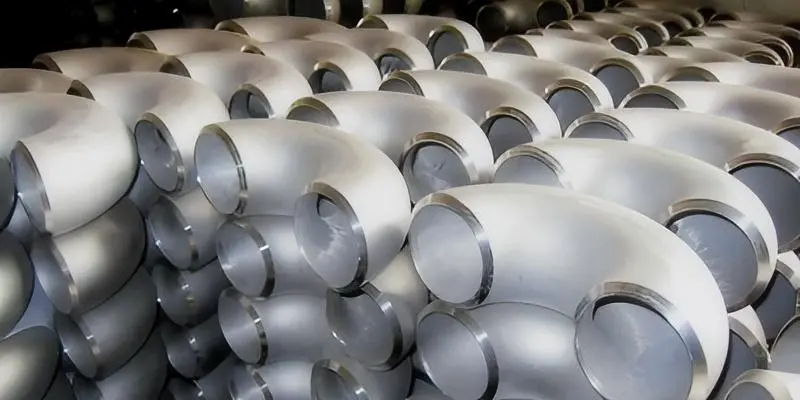
Return bends are bulky for their weight, so they are crated by size and radius and never by order line. Two parts of the same nominal size in different radii look alike on a pallet and are separated only by a label, which is the mix-up a shared crate invites.
Both bevels are capped and the end faces stand clear of the crate floor. A chipped bevel on a return bend is two repairs at once, because both ends face the same direction and both are exposed on the same side of the crate.
Stock, Repeat Orders and Phased Release
Long radius returns in carbon steel and in 304 and 316 stainless are the ones we keep in depth, from NPS 1 to NPS 12 in Schedule 40 and 80. Short radius and the larger sizes come from the mill, and the lead time then moves with the mill programme rather than with ours.
A coil shop that builds the same bundle every quarter can hold the second half of the order against a call-off, so the shelf stays clear without a second purchase decision. Fixing the price and the heat number when the first order is placed is what makes that arrangement worth having rather than merely tidy.
How We Confirm the Specification Before We Quote
We ask what the loop carries and where it sits before we quote, because the same size and radius in a sour refinery coil and in a cooling water return are two different purchases. That question costs a minute and can save a weld repair.
If a manifold drawing shows one centre-to-centre figure and the bill of materials shows another, we quote both and mark the difference rather than choosing one to price. A buyer who sees the conflict can settle it with his engineer in an afternoon; a buyer who does not sees it on the shop floor with a bundle already tacked together.
Return Bend, U-Bend or Fabricated Loop: Naming the Part Correctly
The trade uses three names for this family and they are not interchangeable in an enquiry. A return bend is the standard fitting supplied to B16.9; a U-bend is the same shape made to a drawing with a radius that no standard covers; a fabricated loop is two elbows and a length of pipe welded together on site.
Saying which one is wanted changes the price and the lead time by a wide margin. A standard return bend can be quoted against a stock or mill programme within the hour, while a U-bend drawn on a customer's own radius needs a form and a first article before anyone can promise a date.
Why Choose Xi'an QinSteel for 180Deg Elbow Supply
We ask for the centre-to-centre figure before we price a return bend, because a long radius part and a short radius part of the same nominal size are not interchangeable, and a coil shop will not discover the difference politely when the bundle is already tacked. Two measurements taken on the enquiry beat a return shipment across an ocean, and they take the buyer less time than reading this paragraph. It is the one question that separates a loop that fits from a loop that has to be cut out and rewelded.
We keep a surface plate in the inspection bay for this family of fittings, since alignment of the two end faces is where a return bend most often drifts during production and it stays invisible until the part is offered up to a manifold at the fabricator. A twist of two millimetres is nothing at all on a bench and a great deal on a tube bundle. That is why the plate sits in the bay rather than in a cupboard.
We would rather spend five minutes explaining how the two return patterns differ than a month handling a fitting that has to come back, so a question about radius, wall or alignment gets a measurement and a reference instead of an assurance. Write to info@sxqinsteel.com or open www.sxqsteel.com and the same engineer picks it up.
| NPS | OD at bevel | LR centre-to-centre O | LR back-to-face K | SR centre-to-centre O | SR back-to-face K |
|---|---|---|---|---|---|
| 1 | 33.4 | 76 | 56 | 51 | 41 |
| 1 1/2 | 48.3 | 114 | 83 | 76 | 62 |
| 2 | 60.3 | 152 | 106 | 102 | 81 |
| 3 | 88.9 | 229 | 159 | 152 | 121 |
| 4 | 114.3 | 305 | 210 | 203 | 159 |
| 6 | 168.3 | 457 | 313 | 305 | 237 |
| 8 | 219.1 | 610 | 414 | 406 | 313 |
| 10 | 273.0 | 762 | 518 | 508 | 391 |
| 12 | 323.8 | 914 | 619 | 609 | 467 |
Frequently Asked Questions
1.Is a 180Deg Elbow the same as two 90 degree elbows?
Not for specification purposes. A return bend is one fitting with a single heat number, two welds and a fixed radius, while two elbows welded together produce a fabricated loop with four welds and a centre distance set by whatever spool piece is put between them.
2.Are short radius returns available in every size?
No. Short radius 180 degree returns begin at NPS 1 in most mill programmes and the range thins out at the large end, so a short radius part above NPS 12 is usually a mill order with a long lead time.
3.How do I check a return bend when it arrives?
Measure the centre-to-centre distance across the two end faces, measure the back-to-face height, then stand the fitting on a surface plate and check that both faces sit flat. Those three readings cover the two dimensions and the alignment that matter.
Contact Xi'an QinSteel for 180Deg Elbow Solutions
Tell us the size and the centre-to-centre distance for a 180Deg Elbow, add the wall, the grade and the end preparation, and the answer comes back with a price, a lead time and the certificate options stated against each. Email info@sxqinsteel.com or write through www.sxqsteel.com; a marked drawing of the coil or manifold attached to the enquiry shortens the exchange to a single reply.
References
1.ASME B16.9-2018, Factory-Made Wrought Buttwelding Fittings, American Society of Mechanical Engineers.
2.ASME B16.25-2017, Buttwelding Ends, American Society of Mechanical Engineers.
3.ASME B36.10M-2018, Welded and Seamless Wrought Steel Pipe.
4.ASTM A234/A234M-23, Piping Fittings of Wrought Carbon Steel and Alloy Steel for Moderate and High Temperature Service.
5.ASME B31.3-2022, Process Piping.
6.EN 10253-2:2021, Butt-welding pipe fittings - Part 2: Non alloy and ferritic alloy steels with specific inspection requirements.
Learn about our latest products and discounts through SMS or email