- English
- French
- German
- Portuguese
- Spanish
- Russian
- Japanese
- Korean
- Arabic
- Greek
- German
- Turkish
- Italian
- Danish
- Romanian
- Indonesian
- Czech
- Afrikaans
- Swedish
- Polish
- Basque
- Catalan
- Esperanto
- Hindi
- Lao
- Albanian
- Amharic
- Armenian
- Azerbaijani
- Belarusian
- Bengali
- Bosnian
- Bulgarian
- Cebuano
- Chichewa
- Corsican
- Croatian
- Dutch
- Estonian
- Filipino
- Finnish
- Frisian
- Galician
- Georgian
- Gujarati
- Haitian
- Hausa
- Hawaiian
- Hebrew
- Hmong
- Hungarian
- Icelandic
- Igbo
- Javanese
- Kannada
- Kazakh
- Khmer
- Kurdish
- Kyrgyz
- Latin
- Latvian
- Lithuanian
- Luxembou..
- Macedonian
- Malagasy
- Malay
- Malayalam
- Maltese
- Maori
- Marathi
- Mongolian
- Burmese
- Nepali
- Norwegian
- Pashto
- Persian
- Punjabi
- Serbian
- Sesotho
- Sinhala
- Slovak
- Slovenian
- Somali
- Samoan
- Scots Gaelic
- Shona
- Sindhi
- Sundanese
- Swahili
- Tajik
- Tamil
- Telugu
- Thai
- Ukrainian
- Urdu
- Uzbek
- Vietnamese
- Welsh
- Xhosa
- Yiddish
- Yoruba
- Zulu
Common Surface Coating Types for Grade B7 Hex Bolts
Aug 5 2026
Grade B7 Hex Bolt is a high-strength alloy steel fastener compliant with ASTM A193 standard, widely applied in petrochemical, power generation, mechanical engineering and high-temperature industrial scenarios. Its surface coating treatment is a core process that directly determines the bolt’s corrosion resistance, friction performance, service life and environmental adaptability. Different coating types are tailored to diverse working conditions, ranging from conventional atmospheric environments to harsh high-temperature and corrosive working scenarios. Selecting a suitable surface coating can effectively avoid bolt oxidation, rust and mechanical performance degradation, ensuring the stable and long-term operation of mechanical connection systems.
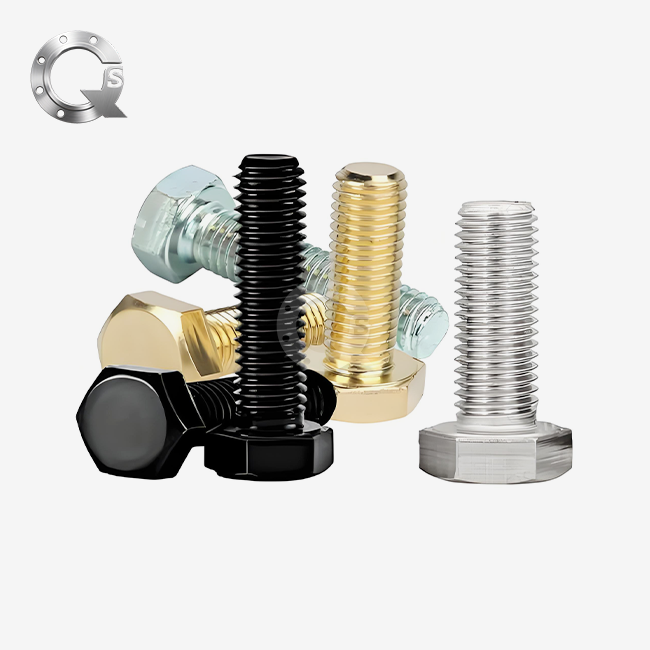
1. Plain Finish (Bare Metal)
Plain finish is the most original surface treatment for Grade B7 Hex Bolts without any additional coating or chemical treatment. It retains the inherent metallic texture and mechanical properties of B7 alloy steel completely. This type of finish is suitable for indoor, dry and non-corrosive working environments with low humidity and no chemical erosion. The biggest advantage of plain finish bolts is that there is no coating peeling or failure problem under high-temperature conditions, which fully retains the high-temperature resistance and tensile strength of Grade B7 Hex Bolts. However, bare metal surfaces are prone to oxidation and rust in humid or outdoor environments, so regular anti-rust maintenance is required during storage and use.
2. Black Oxide Coating
Black oxide coating, also known as blackening treatment, is a common chemical surface treatment for high-strength fasteners. The process forms a dense black oxide film on the surface of Grade B7 Hex Bolts through chemical reaction, with ultra-thin coating thickness that will not affect the bolt’s assembly accuracy and thread matching. This coating improves the surface wear resistance of the bolt and reduces friction during installation. Meanwhile, the matte black appearance enhances the overall aesthetics of mechanical equipment. It is mostly used for indoor mechanical parts, general equipment connections and low-corrosion working conditions. To further improve anti-rust performance, black oxide coated bolts are usually matched with oil sealing treatment after processing.
3. Zinc Plating (Electro Galvanizing)
Electro zinc plating is one of the most widely used anti-corrosion coatings for fasteners. A uniform zinc layer is electroplated on the surface of Grade B7 Hex Bolts, which provides excellent sacrificial anode protection. When the surface is slightly scratched, the zinc layer will corrode preferentially to protect the internal alloy steel matrix from rusting. Conventional zinc plating can be divided into white zinc, yellow zinc and color zinc passivation treatments, with different anti-corrosion grades. This coating features low cost, stable performance and good decorative effect, suitable for outdoor conventional atmospheric environments, construction machinery and general industrial equipment. It is worth noting that electro zinc plating is not recommended for long-term high-temperature working scenarios, as high temperature will accelerate the aging and failure of the zinc coating.
4. Hot-Dip Galvanizing (HDG)
Hot-dip galvanizing is a heavy-duty anti-corrosion coating process for Grade B7 Hex Bolts. Different from electro galvanizing, this process immerses the bolt in high-temperature molten zinc liquid to form a thick, firm and impact-resistant zinc coating. The coating has strong adhesion and excellent anti-corrosion ability, which can resist severe weather erosion such as rainwater, salt fog and coastal humidity. It is widely used in outdoor engineering, marine equipment, bridge facilities and outdoor pipeline connection scenarios. The disadvantage is that the coating thickness is relatively large, which may slightly affect the thread fit, so thread matching tolerance needs to be reserved in advance during production and processing.
5. PTFE and Xylan Coating
PTFE (polytetrafluoroethylene) and Xylan series coatings are high-performance composite coatings for high-end industrial fasteners. These coatings are uniformly sprayed and cured on the surface of Grade B7 Hex Bolts, integrating corrosion resistance, high temperature resistance, low friction and self-lubricating properties. They can resist chemical corrosion such as acid and alkali, and maintain stable performance in high-temperature working environments up to 260℃. In addition, the ultra-low friction coefficient effectively avoids thread jamming, galling and loosening during bolt disassembly and assembly. They are the preferred coating solution for high-end equipment, precision machinery, chemical industry and high-temperature pipeline fastening scenarios.
6. Electroless Nickel Plating
Electroless nickel plating is a high-precision surface coating process for Grade B7 Hex Bolts. Compared with traditional electroplating, this process forms a uniform, dense and pinhole-free nickel alloy coating on the bolt surface without power supply. The coating has high hardness, good wear resistance and excellent chemical stability, and can effectively resist acid, alkali and salt fog corrosion. Moreover, the coating thickness is uniform on threads and complex surfaces, which will not affect the precision assembly of bolts. It is mainly used for precision mechanical equipment, aerospace auxiliary parts, chemical reaction equipment and other high-precision and high-corrosion working scenarios.
FAQs
Q1: Which coating is the most cost-effective for conventional outdoor use of Grade B7 Hex Bolts?
A1: Electro zinc plating with yellow passivation is the most cost-effective choice for conventional outdoor atmospheric environments. It balances anti-corrosion performance and production cost, fully meeting the daily anti-rust and protection needs of outdoor equipment fastening.
Q2: Can coated Grade B7 Hex Bolts be used in high-temperature working conditions?
A2: It depends on the coating type. PTFE and Xylan coatings have good high-temperature resistance and can adapt to medium and high-temperature environments. Zinc plating and hot-dip galvanizing are not suitable for long-term high-temperature use, while plain finish bolts are the most reliable for ultra-high-temperature working scenarios.
Q3: Is it necessary to customize supporting nuts for HDG Grade B7 Hex Bolts?
A3: Yes. The thick hot-dip galvanized coating will reduce the thread gap. It is necessary to match enlarged threaded nuts to ensure smooth assembly and avoid thread damage during installation.
Contact QinSteel for Premium Grade B7 Hex Bolt Coating Solutions
As a professional manufacturer and supplier of high-strength industrial fasteners, QinSteel provides customized surface coating services for Grade B7 Hex Bolts to meet diverse working condition requirements. We support plain finish, black oxide, zinc plating, HDG, PTFE/Xylan coating and electroless nickel plating processing, with strict compliance with ASTM industry standards and full quality inspection reports. Whether you need conventional anti-corrosion bolts or high-precision and high-temperature resistant coated fasteners, we can provide one-stop customized solutions and stable supply support. For product parameters, customized schemes, bulk quotation and technical consultation, please send your demands to our official email: info@sxqinsteel.com. Our professional technical team will reply and provide targeted solutions within 24 hours.
References
[1] ASTM A193 Standard Specification for Alloy-Steel and Stainless Steel Bolting for High Temperature or High Pressure Service and Other Special
Learn about our latest products and discounts through SMS or email