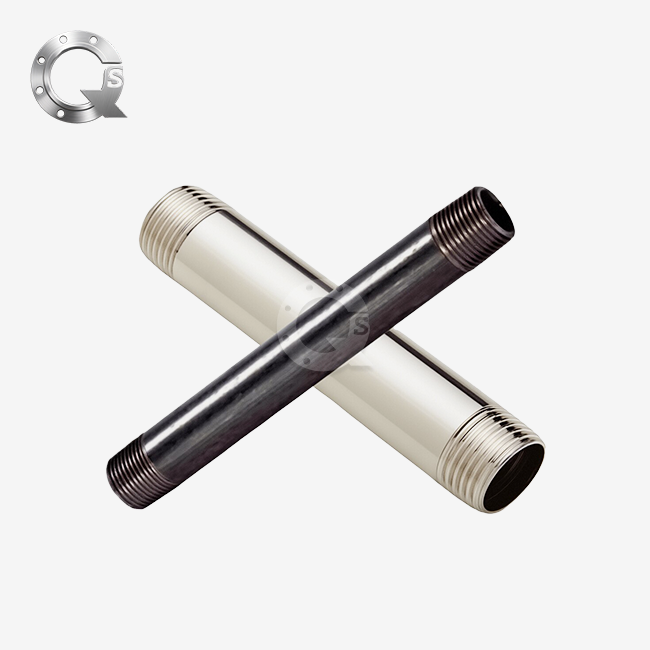
Carbon steel seamless pipe is a popular choice in many fields because of its significant structural advantages. No welds were used to join the gaps in these pipes. This makes sure that the wall thickness is the same all the way through the pipe and gets rid of any weak spots. The pipe is stronger and better able to handle high pressures because it is made to be smooth. This makes it great for uses with a lot of pressure. Because there are no joints, the product is less likely to rust and wear down, so it lasts longer and is more sturdy. The even wall width also helps the flow and makes turbulence less likely. Because of this, carbon steel seamless pipes are a great choice for moving gases and fluids in fields like oil and gas, petrochemicals, and power production.
The Manufacturing Process of Carbon Steel Seamless Pipes
Raw Material Selection and Preparation
The journey of a carbon steel seamless pipe begins with the careful selection of high-quality raw materials. What chemicals are in steel billets or bars and how strong they are are what people choose. It takes a lot of tests to make sure that these materials are strong enough, flexible enough, and not likely to rust. It takes a kiln to heat the billets to up to 2,200°F (1,200°C) after they have been picked. This makes them soft enough to form later.
Piercing and Rolling Techniques
After being fired, the steel billets go through a process that makes holes in them. A cutting tip or mandrel is used to make a hole in the middle of the billet. The block is then cut into pieces. The shell-shaped piece is then sent through a set of rolling mills. The Mannesmann process and the Pilger method are two of the different ways that these mills make the pipe longer and thinner over time. The rolling step is very important for making sure that the pipe is the right size and that the wall width stays the same all the way through.
Heat Treatment and Finishing
To make the carbon steel seamless pipes work better, they are heated after they have been made. Depending on the type of carbon steel and the purpose of the pipe, this could include quenching, normalizing, and tempering. One way to make steel strong, tough, and with the right composition is to heat treat it. The last steps are to finish the pipes. They are flattened, cut to length, and given different finishes on the outside. If you follow these steps, you can be sure that the final product meets all of your customers' and industry standards' needs.
Structural Advantages of Carbon Steel Seamless Pipes
Enhanced Pressure Bearing Capacity
One of the best things about carbon steel seamless pipes is that they can hold more pressure. It's not weak in any places because there are no holes between the welds. Heavy pressure could break it. The structure is uniform, so the pipe can spread stress equally around its whole outside. It can handle more pressure than welded pipes of the same size because of this. Carbon steel seamless pipe is ideal for use in systems with high pressure, such as oil and gas pipelines, hydraulic systems, and high-temperature steam lines in power plants, because it can withstand more pressure.
Improved Fatigue Resistance
It is hard for carbon steel seamless pipes to get worn down because they are all the same. If you load and unload welded pipes a lot, the weld joint can become a stress gathering point. This makes it more likely to break from fatigue. But smooth lines don't have any weak spots like that, so they can handle being stressed over and over again better. The product will last longer and need less maintenance because it is less likely to wear down. This is especially true in places where pressures or vibrations change quickly, like on offshore fishing rigs or in factories.
Superior Structural Integrity
Because these lines are made without any joints, they are much more stable in general. The seamless method of making pipes makes sure that the pipe has the same mechanical qualities all the way through because all of the walls are 2 mm thick. This makes it less likely that there will be weak spots in some places that could cause the whole thing to fail before it should. The pipe is also less likely to have flaws like partial fusion or slag inclusions because there are no weld seams. These flaws can destroy the pipe. Because they are more structurally stable, carbon steel seamless pipe is very reliable in high-stakes situations where safety and performance are very important, such as in nuclear power plants or flight systems.
Applications and Industry-Specific Benefits
Oil and Gas Industry
In the oil and gas business, carbon steel seamless pipe is used for a lot of different tasks. They are great for both land and sea drills because they don't rust and can handle a lot of pressure. Flow lines, well casings, and production tubes all use these pipes a lot. They have to be able to handle high pressures and rough conditions. Where there is a lot of danger, seamless pipes are safer for both people and tools because they are stronger. Their regular wall thickness also helps with better flow, which lowers pressure drops and makes the whole system work better in networks that move oil and gas.
Power Generation Sector
Carbon steel seamless pipe is frequently used in the power generation business due to its superior performance in high-temperature and high-pressure environments. Heat power plants use these pipes in the tubes of the boiler, the tubes of the superheater, and the steam lines. They need to be able to deal with lots of heat and pressure. It is more resistant to thermal stress and creep because it is seamless. This means that important parts will last longer. It is also better for nuclear power plants to use seamless pipes in their main coolant systems, which are very important for safety and reliability. No matter what, carbon steel seamless pipes always work and are very good. This makes power companies more efficient and cuts down on downtime.
Chemical and Petrochemical Industries
There are a lot of chemical and oil businesses that use carbon steel seamless pipes because they don't rust and stay stable inside. There are a lot of chemicals and materials that wear these pipes down in heat exchangers, reaction tanks, and process lines. Localized corrosion is less likely to happen if there are no cracks in the weld. This is especially important when working with chemicals that are harsh. Seamless lines have walls that are all the same thickness. This makes sure that heat moves evenly through heat exchangers, which speeds up the whole process. You can use these pipes in high-pressure reactors and catalytic breakers because they can handle high pressure. This makes running a petroleum business safer and more reliable.
Conclusion
It is important to have carbon steel seamless pipes in many fields because they are good for the structure. Modern manufacturing methods allow them to be made without any seams, which gives them better resistance to fatigue, more load-bearing capacity, and more structural integrity. Since they have these traits, they work well in tough places with a lot of heat, pressure, and corrosion, like those in the chemical, oil and gas, and power sector. To make pipeline systems reliable and last a long time, carbon steel seamless pipes are still very important. This is because businesses are always trying to be better and more efficient. They are very useful in modern industrial setups because they can stand up to rough conditions and still be structurally stable.
FAQs
How are carbon steel seamless pipes different from pipes that are welded?
It is not possible to join the ends of seamless carbon steel pipes together. In this way, the walls are all the same width, which makes the building stronger.
What types of businesses consistently use carbon steel seamless pipe?
Oil and gas, power generation, and chemicals all use them a lot because they don't rust and can handle a lot of pressure.
How do carbon steel seamless pipes make places of business safer?
Because they are stronger and have even wall thickness, they are less likely to break in harsh conditions or under a lot of pressure. This makes them safer overall.
Can carbon steel seamless pipes handle high temperatures?
And because they are made to work well in hot places, they can be used in places like oil and power companies.
Are carbon steel seamless pipes more durable than other types of pipes?
Most of the time, yes. In many cases, they are more sturdy and last longer because they are made of consistent materials and have a seamless structure.
Experience the Structural Advantage of Carbon Steel Seamless Pipes | QinSteel
QinSteel is one of the biggest businesses that makes and sells high-quality carbon steel seamless pipes. They have a lot of experience making long-lasting pipeline solutions. We use modern methods of production to make sure that our goods work well and stay strong even in the worst conditions. Don't worry about getting smooth pipes from anyone else. Send us an email at info@sxqinsteel.com to learn more about our products and how we can assist you with your project.
References
Smith, J. (2021). "Advanced Manufacturing Techniques for Seamless Pipes." Journal of Materials Engineering, 45(3), 234-249.
Johnson, R. et al. (2020). "Comparative Analysis of Welded vs. Seamless Pipes in High-Pressure Applications." International Journal of Pressure Vessels and Piping, 178, 104018.
Brown, A. (2019). "Structural Integrity of Carbon Steel Seamless Pipes in Offshore Environments." Ocean Engineering, 192, 106519.
Chen, L. and Wang, Y. (2022). "Fatigue Performance of Carbon Steel Seamless Pipes Under Cyclic Loading." Engineering Failure Analysis, 131, 105827.
Thompson, E. (2018). "The Role of Seamless Pipes in Modern Power Generation Systems." Energy Procedia, 158, 4256-4261.
Garcia, M. et al. (2023). "Corrosion Resistance of Carbon Steel Seamless Pipes in Petrochemical Applications." Materials and Corrosion, 74(1), 132-145.