- English
- French
- German
- Portuguese
- Spanish
- Russian
- Japanese
- Korean
- Arabic
- Greek
- German
- Turkish
- Italian
- Danish
- Romanian
- Indonesian
- Czech
- Afrikaans
- Swedish
- Polish
- Basque
- Catalan
- Esperanto
- Hindi
- Lao
- Albanian
- Amharic
- Armenian
- Azerbaijani
- Belarusian
- Bengali
- Bosnian
- Bulgarian
- Cebuano
- Chichewa
- Corsican
- Croatian
- Dutch
- Estonian
- Filipino
- Finnish
- Frisian
- Galician
- Georgian
- Gujarati
- Haitian
- Hausa
- Hawaiian
- Hebrew
- Hmong
- Hungarian
- Icelandic
- Igbo
- Javanese
- Kannada
- Kazakh
- Khmer
- Kurdish
- Kyrgyz
- Latin
- Latvian
- Lithuanian
- Luxembou..
- Macedonian
- Malagasy
- Malay
- Malayalam
- Maltese
- Maori
- Marathi
- Mongolian
- Burmese
- Nepali
- Norwegian
- Pashto
- Persian
- Punjabi
- Serbian
- Sesotho
- Sinhala
- Slovak
- Slovenian
- Somali
- Samoan
- Scots Gaelic
- Shona
- Sindhi
- Sundanese
- Swahili
- Tajik
- Tamil
- Telugu
- Thai
- Ukrainian
- Urdu
- Uzbek
- Vietnamese
- Welsh
- Xhosa
- Yiddish
- Yoruba
- Zulu
Hot Forged Flange vs Cast Flange: Which Holds Up Under Pressure?
Oct 2 2026
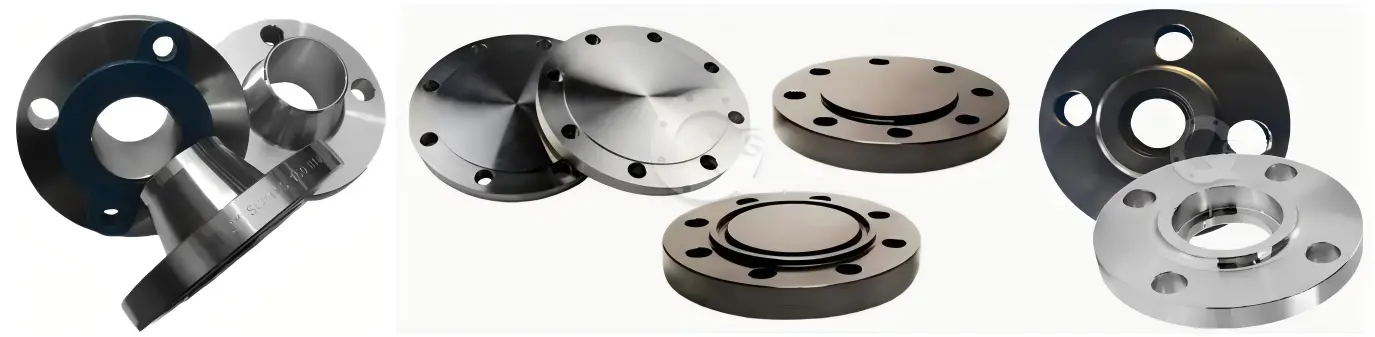
A Hot Forged Flange and a cast flange may look alike on the shelf, but they behave very differently once the line is pressurized and the joint starts to move. The difference comes from how the metal is made, not from the drawing. We get asked this comparison most often by buyers who have been burned by a cast part that cracked at hydrotest or after a few thermal cycles. The short answer is that forging gives you a denser, tougher joint, while casting gives you a cheaper part that is fine only where the load stays mild. Here we lay out where each one earns its place.

What Casting Leaves Behind
A cast flange is poured into a mould, so the metal freezes where it lands and any shrinkage shows up as porosity or a weak spot. That is acceptable for a low-stress water line but risky for a joint that sees swing or shock. We have opened returned cast spares where a void sat right at the bolt circle, invisible until the line was tested. A forged flange removes most of that risk because the compressive force squeezes the structure tight during shaping. For a buyer, the practical question is not price per piece but cost of the failure that a void can cause.
We have seen the failure mode from the receiving end. A cast blind that passed its own foundry test opened a void along the hub after eighteen months of thermal cycling, and the weep only appeared when the line was hot. Nothing in the paper trail was wrong; the process had left a weak path that pressure alone could not reveal. The forged replacement has held since.
There is also the question of repair. A casting that develops a weep can sometimes be welded, but the repair introduces a new heat-affected zone next to the original defect and the joint is rarely the same afterwards. A forging in the same service is normally replaced rather than repaired, which sounds like a worse outcome until you count the shutdowns that a patchwork of repairs costs over five years.
How Forging Closes the Voids
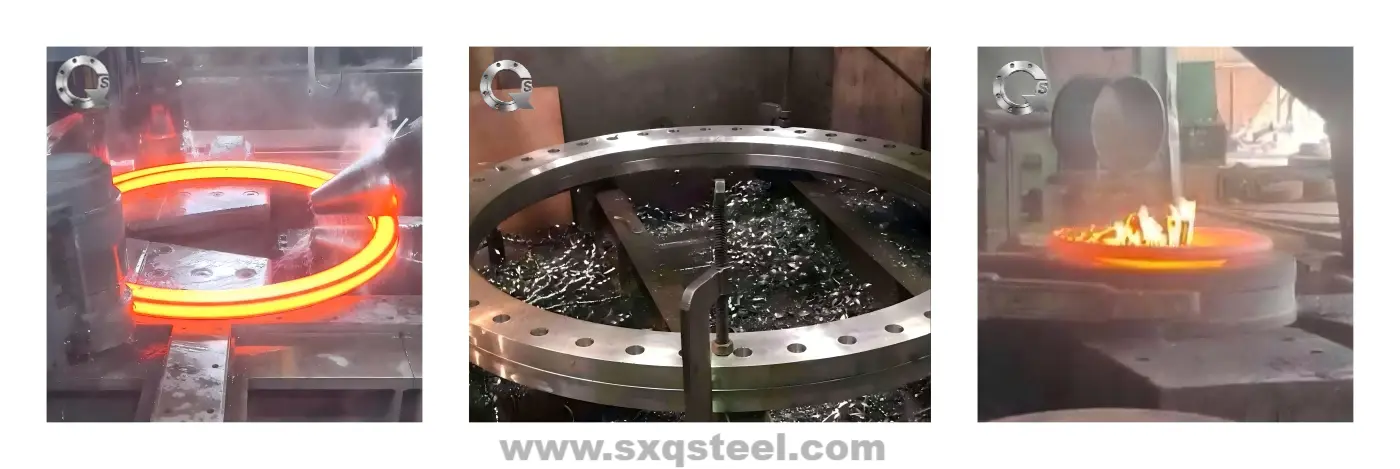
The hot forged flange process heats the billet until it is plastic, then presses it so the grain bends around the hub and the rim. That bending is what closes the microscopic gaps that casting leaves open. The result is a part with consistent density from face to bore. We section test pieces from every new die so the grain pattern is on file before a run ships. A buyer who sees that section photo tends to stop asking why forged costs a little more and starts asking how soon we can load the container.
Pressure Rating Reality
A hot forged flange reaches higher classes on the same size because the material is sound and the hub carries load without a weak seam. Cast parts are usually capped at lower classes for the same reason the foundry fears a void at the high end. We stock forged through Class 2500 and rarely see a cast flange quoted above 300 for hydrocarbon duty. When a buyer compares the two on a Class 600 line, the forged option is not a luxury, it is the only one the standard really supports with confidence.
The rating also depends on the size, which buyers often discover when they price a large bore. An NPS 24 at Class 900 is a different problem from an NPS 2 at the same class, because the wall section needed to carry the load grows faster than the bore does. When a client asks whether a size can be made at a class, the answer usually rests on the press and the billet weight.
Buyers sometimes ask whether a cast part can be upgraded to a higher class by adding thickness. The answer is usually no, because the limitation is not the wall but the internal soundness the higher class assumes. Increasing the section on a casting does not remove a void; it surrounds it with more metal. That is the point where the conversation usually moves to a forged alternative. We have made that switch on several lines, and the cost gap was smaller than the buyer expected once the inspection requirements were matched.
Fatigue and Thermal Cycling
Lines that heat and cool, or that see vibration from pumps and compressors, punish a joint at the grain level. A forged flange shrugs off that cycling because the wrapped grain resists crack growth better than a cast structure. A Gulf compressor station we supply switched its suction flanges to forged after two cast failures in one winter. The forged set ran the next season without a weep. For any joint that moves, forging is the safer bet and the cheaper one over the life of the plant.
Cost Versus Risk
Cast flanges win on sticker price, and for a static, low-pressure, indoor line that may be the right call. The forged flange costs more up front but removes a failure mode that can shut a train or spill a product. We help buyers run that math instead of guessing. A Latin American miner kept cast on the water header but moved every hydrocarbon joint to forged, which is exactly the split a risk review should produce. Spend the premium where the consequence of failure is real.
The arithmetic is easier than it looks. A cast part may save a few hundred dollars on the invoice, while one unplanned shutdown on a hydrocarbon line runs into tens of thousands an hour. We have quoted both options on the same site for different lines, and the split usually falls where the consequence of failure changes rather than where the diameter changes.
Why Choose Xi'an QinSteel for Your Flange Supply
When a buyer switches from cast to a forged flange, the cert and the traceability matter more, not less, because the whole point was to remove doubt. We issue EN 10204 3.1 with every forged shipment and keep the heat record tied to the bundle label. A West African EPC told us their inspector signed off faster on our packs than on any other supplier's. That trust is built on documents that match the metal, every time the container is opened.
Certificates are only worth what the person reading them can verify, so we keep the marking, the heat number, and the 3.1 sheet pointing at the same piece of steel. A West African inspector once cleared a whole container from our photographs alone, which told us the file was doing its job.
The confirmation is not bureaucracy; it is the last chance to fix a mistake on paper instead of in the yard. We would rather slow the cut by a day than ship a part that cannot mate. On top of that, the melt and heat number travel on the bundle label, so the paper and the part can be matched on the deck without opening every crate.
How We Verify Before We Ship
Every forged flange we ship passes a visual and dimensional check, and the destructive or UT check is done on the die sample rather than the piece when the class allows. We photograph the facing and the marking so the buyer can confirm before fit-up. A Southeast Asian contractor used our photos to clear a client audit without a site visit. That level of proof is what makes a forged purchase feel safe rather than speculative.
Verification is built into the route rather than added at the end. The bore, the facing, and the bolt circle are checked against the drawing after machining, and the marking is photographed before the bundle is closed. A Gulf fabricator once caught a facing mix-up on that photo while the steel was still in our yard, and we swapped the parts before the truck left.
Mechanical evidence comes from the heat rather than the piece: tensile and impact results are taken from the coupon that travelled with the melt, and UT or MPI is applied where the service pays for it. A forging's soundness is set by the process, so a batch result describes the parts honestly. We keep the coupon data with the certificate.
When Cast Is Still the Right Answer
We are not against cast parts; we are against cast parts in the wrong joint. For a low-pressure utility header that is easy to reach and cheap to replace, cast can be the sensible choice. The mistake is letting price decide on a line where the consequence of a failure is a shutdown or a spill. Tell us the duty and we will tell you plainly whether a hot forged flange is worth it or whether a cast option will do. Honest scoping beats a blanket rule either way.
A buried main that nobody will inspect again does not need a forging, and telling a municipal buyer otherwise would only raise his budget for nothing. The same goes for an indoor header that can be isolated over a weekend. Our advice there is to spend the money on coating and bedding instead, because corrosion, not grain structure, is what ends those joints.
| Factor | Hot forged flange | Cast flange |
|---|---|---|
| Internal soundness | Dense, voids closed | Porosity risk |
| Max class typical | Up to 2500 | Up to 300 |
| Fatigue resistance | High | Moderate |
| Upfront cost | Higher | Lower |
| Best use | Pressure, swing, impact | Static low-pressure |
| Cert rigor | 3.1 standard | Varies |
Frequently Asked Questions
1.Should I always pick forged over cast?
No. For static, low-pressure, easy-to-reach lines, cast can be the right economical choice. Forged earns its premium where pressure, fatigue, or consequence of failure is high.
2.Why does forged reach higher pressure classes?
Because the material is dense and the grain follows the shape, so the hub carries load without a weak seam. Cast parts are limited by the risk of a void at the high end.
3.Can a cast flange be certified to 3.1?
It can be documented, but the foundry's process controls vary more than a forge's. We recommend forged where the cert rigor is part of the safety case.
Contact Xi'an QinSteel for Hot Forged Flange Solutions
For pricing and lead time on Hot Forged Flange stock or a made-to-order run, email info@sxqinsteel.com or open www.sxqsteel.com. Our team checks your drawing, confirms the material and pressure class, and replies with a firm quote the same business day for standard sizes.
References
- ASTM A105 / A105M - Carbon Steel Forgings for Piping Applications.
- ASTM A216 / A351 - cast carbon and stainless steel flanges and fittings.
- ASME B16.5 - Pipe Flanges and Flanged Fittings.
- ASME B16.47 - Large Diameter Steel Flanges.
- ISO 10474 / EN 10204 - Inspection documents, 3.1 and 3.2.
- API 570 - Piping Inspection Code, in-service joint integrity.
Technical content prepared by the Xi'an QinSteel flange team. For stock lists and specification help, visit www.sxqsteel.com.
Learn about our latest products and discounts through SMS or email